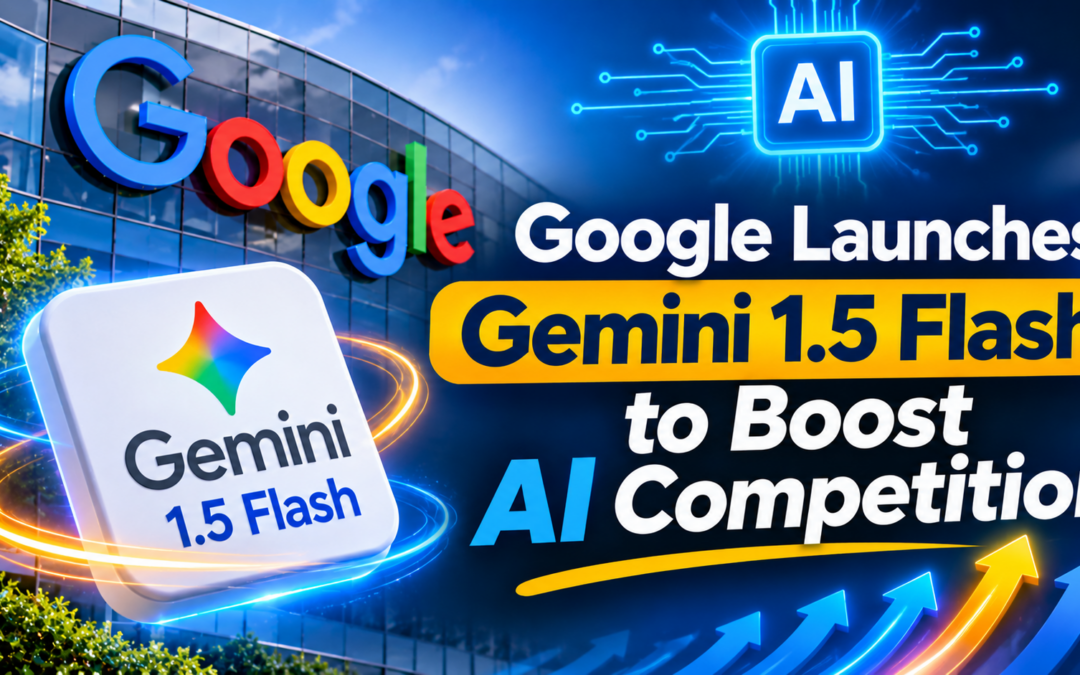
Generative AI competition has reached a new boiling point, as Google unveils Gemini 1.5 Flash, a faster, more efficient language model, along with updates to its Gemini API platform. As AI developers and founders hunt for speed, cost reductions, and high-fidelity model outputs, Google’s latest moves promise to reset expectations for large language model (LLM) performance — and signal intense acceleration in the broader AI race across enterprise and consumer applications.
- Google launches Gemini 1.5 Flash, a lightweight, speedy LLM for high-volume and real-time use cases
- Significant Gemini API updates enable broader context windows and advanced tool integrations
- Direct competition heats up with OpenAI’s GPT-4o, Anthropic’s Claude 3, and Meta’s Llama 3
- Expanded multimodal capabilities across Gemini ecosystem target real-world deployment needs
- Broader implications for developers, AI startups, and businesses building generative AI products
Key Takeaways: Why Gemini 1.5 Flash and Google’s AI Upgrades Matter Now
Google has directly responded to surging demand for real-time, cost-effective large language models with the release of Gemini 1.5 Flash. This new model is designed to deliver high-speed inference at a fraction of the computational load required by its flagship Gemini 1.5 Pro sibling. Developers and AI product builders now have a meaningful choice: target super-powered reasoning with Gemini Pro, or scale lightweight deployments via Flash.
“By introducing a genuinely lightweight generative model alongside deep API upgrades, Google is signaling the next phase: rapid scaling of AI into the heart of mainstream software.”
For enterprises, Google’s expanded ecosystem challenges recent advances from OpenAI and Anthropic, aiming to reclaim pole position in both capability and adoption. Importantly, Google is placing Gemini at the core of its consumer applications and platform offerings, including Gmail, Workspace, and Android, further amplifying its reach.
Gemini 1.5 Flash: Built for Scale, Speed, and Cost Efficiency
Addressing pain points in AI deployments, Gemini 1.5 Flash was engineered from the ground up to handle chatbots, content moderation, summarization, and dynamic multimedia analysis — all with tuned latency and resource demands. The model supports context windows up to 1 million tokens, catering to document-heavy or dialog-rich applications, while using less server horsepower compared to Pro models.
According to Google, Gemini 1.5 Flash can process vast amounts of text, images, and other multimodal inputs at a price-performance ratio aimed squarely at commercial AI builders. This release positions the Flash variant as an ideal choice for large-scale production workloads from startups and mature enterprises alike.
“Access to affordable, high-speed LLMs will dictate which AI products break out commercially over the next year.”
Gemini API Expands Capabilities and Developer Reach
Alongside new models, Google has rolled out enhancements to the Gemini API suite. These upgrades include:
- Expanded Access: Advanced context windows up to 2 million tokens (in private preview) for Gemini 1.5 Pro
- Improved Tooling: Seamless integration with Google’s search, code understanding, and data analysis tools
- Global Reach: Multilingual model access and regionally distributed endpoints for latency-sensitive applications
Notably, API upgrades and supporting SDKs make it easier for teams to build robust chatbots, summarize massive documents, and process mixed media data at scale. Google’s developer documentation emphasizes cross-platform compatibility, with integrations for Python, Node.js, and other major frameworks.
“LLM platform wars will be won by those ecosystems that lower both cost and barrier to multimodal, massively contextualized AI applications.”
Competing Directly with OpenAI, Anthropic, and Meta
Google’s Gemini upgrades respond directly to recent stride from OpenAI’s GPT-4o, which brought multimodal functionality and near-instant responses, and Anthropic’s Claude 3, noted for its large context windows and advanced reasoning. Meta’s open-source Llama 3 series also pressures incumbents by enabling broad experimentation and cost reduction.
With the Gemini 1.5 Flash unveiling, Google’s value proposition now includes:
- Flexible workload matching — high-end “Pro” for deep reasoning, Flash for real-time scale
- Massive context support — up to 2 million tokens in preview
- Core integration into Google’s cloud AI platform, Android, Workspace, and more
“The expanding generative AI landscape means developers must evaluate not just model accuracy, but deployment cost, latency, and cross-platform reach.”
Industry analysts point to a trend: AI companies now race not just on general intelligence, but on platform openness, regional compliance, and adaptive pricing models to suit diverse use cases.
Broader Multimodal AI for Real-World Applications
Gemini 1.5 models and their underlying API ecosystem are built for multimodal input — meaning text, code, image, and even video streams. This capability empowers next-generation search, knowledge assistants, data summarization, and content moderation solutions popular with SaaS startups and enterprise product teams.
Development teams can now leverage Gemini’s multimodal prowess to parse PDFs, scan audio transcripts, summarize camera feeds, or integrate contextual search directly within their own apps. The efficiency gains make previously cost-prohibitive use cases (like document-based legal AI agents or live video understanding) suddenly viable.
“Multimodal LLMs are not just a research milestone — they are unlocking service categories that simply didn’t exist before.”
Industry Impact: What’s Next for AI Product Teams?
Google’s aggressive AI portfolio expansion resets the stakes for startups, enterprise LLM initiatives, and independent developers seeking production-grade generative AI capabilities. With more economical, high-performance models, the pathway to mass-market deployment is rapidly shortening.
As Gemini models deploy across consumer and business platforms, expect to see AI-powered features diffuse through mobile devices, productivity software, and customer-facing apps. The key challenge in the months ahead: selecting the optimal model architecture and provider to balance speed, accuracy, context, and cost in every AI product strategy.
“The future belongs to those who can bring intelligent AI to scale without breaking the business model.”
The Next Wave: Accelerating Toward Mass-Market AI
Google’s strategic push with Gemini 1.5 Flash and a bolstered API platform demonstrates that the era of slow, costly, or brittle LLM deployments is drawing to a close. Developers and companies now have more choices — not just for experimentation, but for reliable, scalable, real-world AI solutions powering everything from apps to analytics to customer support. The dexterity and efficiency of the next generation of LLMs will shape the competitive landscape for years to come.
Source: Google Blog