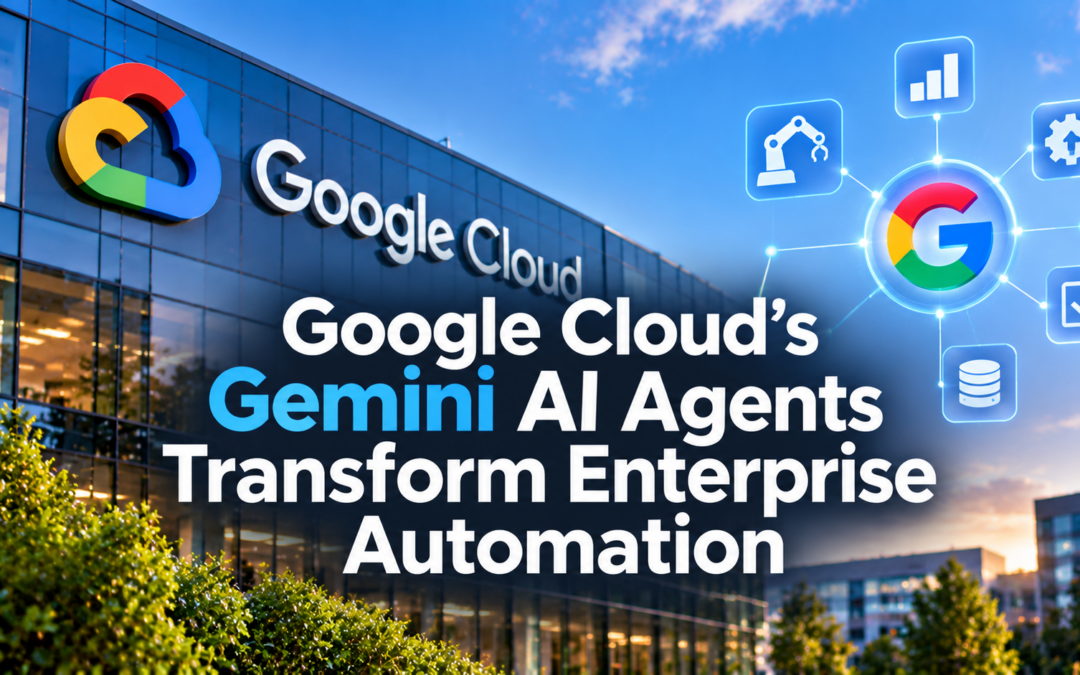
The rapid advance of generative AI is transforming cloud services, and Google’s latest move marks a major escalation. As businesses increasingly rely on large language models (LLMs) for automation and analytics, Google Cloud’s unveiling of new Gemini AI-powered agents signals a direct challenge to rivals like Microsoft and Amazon. This development matters now, as enterprises seek more customizable, scalable, and secure AI solutions to stay competitive in a landscape reshaped by next-gen tooling.
- Google Cloud launches Gemini AI agents for enterprise automation and developer integration
- The update intensifies competition with Microsoft Azure and Amazon Web Services in the AI-driven cloud
- Developers gain access to new APIs, SDKs, and platform-native integration features
- Startups and enterprises face fresh opportunities—and challenges—with advanced AI customization
Key Takeaways: Gemini Agent Ushers in a New Cloud AI Era
Google Cloud’s Gemini agents extend LLM capabilities beyond text generation, positioning the company at the center of the evolving generative AI economy. The initiative introduces prebuilt and customizable agents that can automate business workflows, assist customer support, and directly integrate into enterprise platforms. By enabling developers to rapidly deploy and fine-tune large language model agents, Google aims to accelerate AI adoption for businesses of all sizes.
“The deployment of Gemini agents marks a distinct pivot toward AI-powered orchestration of business operations, not just content generation.”
Google Cloud Gemini Agents: What’s New?
Gemini agents, built on Google’s most advanced LLMs, are now accessible for Google Cloud customers. These agents serve functions ranging from process automation to code completion and customer interaction within enterprise environments. Key offerings include:
- Prebuilt task-specific agents for sales, HR, and IT support workflows
- APIs and SDKs to enable custom agent development on Vertex AI
- Integrated tools for security, privacy, and compliance—critical for regulated industries
- Support for Google Workspace and integration with productivity tools
This positions Google to directly compete with Microsoft’s Copilot (bundled with Azure) and Amazon’s Q agent, both of which have seen rapid enterprise uptake since late 2023 (CRN; CNBC).
“Generative AI platforms that offer seamless agent deployment and deep enterprise integrations will define the next phase of cloud computing.”
AI Agents Move from Conversation to End-to-End Automation
While early LLMs focused on answering questions and generating content, Gemini agents highlight a seismic shift: AI now executes entire processes. Google’s approach bundles conversational skills with actions, pulling data from cloud databases, submitting tickets, or even launching infrastructure. For AI professionals, this means models must be optimized not just for language but context, security, and task orchestration.
Security stands out as a primary concern. Google built in support for confidential AI workloads, policy enforcement, and robust auditing to address rising enterprise demands. These steps mirror similar moves by Microsoft and Amazon, which both tout advanced compliance for their AI offerings.
“AI is evolving from a tool for answers to an operator that takes action—demanding new skills from both developers and the cloud platforms they choose.”
Integration Ecosystem: A Crucial Battleground
Google aims to win over enterprises and developers through deep integration. Gemini agents work directly inside Google Workspace, BigQuery, and partner productivity platforms. This positions them as flexible components in company workflows, reducing implementation friction. Startups and ecosystem partners can also tap APIs to build vertical-specific agents for finance, healthcare, legal, and more.
Similar integration pushes by competitors underscore the market’s direction. Microsoft’s Copilot leverages deep ties across Office 365 and Teams, while AWS is embedding generative AI in cloud management tools and industry-specific offerings.
“Winning the ‘AI agent’ race will depend on who enables the broadest, most secure, and most developer-friendly integration across cloud and productivity apps.”
What This Means for Developers and Startups
For developers, the availability of Gemini APIs and Google’s tooling lowers barriers to experimentation. Startups can now iterate faster on AI-powered products, benefiting from cloud-managed scaling, fine-tuning, and compliance features. At the same time, this explosion of agent frameworks raises questions about interoperability and fragmentation, as different clouds push proprietary standards and toolsets.
Startups building AI-first SaaS must recalibrate their strategies: betting on one ecosystem (Google Cloud vs. AWS vs. Azure) could shape hiring, go-to-market, and technical architectures for years to come.
“Developers now must choose their AI alliances wisely—these decisions will dictate technical flexibility and market reach for the next generation of product innovation.”
Looking Ahead: The Pace of Enterprise Automation Accelerates
As Gemini agents roll out and competitor offerings mature, generative AI is poised to automate an expanding range of business operations. Enterprises will demand not only smarter agents, but those that are trustworthy, auditable, and deeply embedded into daily operations. Expect continued arms races by cloud providers around agent performance, security features, integration options, and industry partnerships. The organizations that harness these new AI building blocks quickly—and wisely—will set the pace in tomorrow’s economy.
Source: Reuters