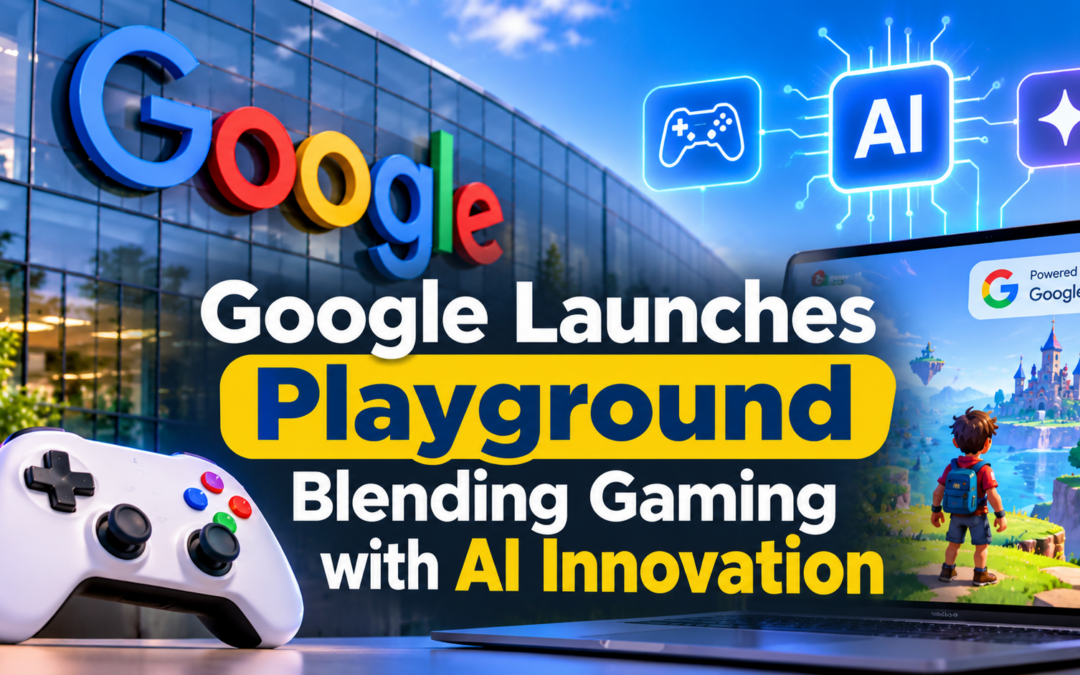
The boundaries between gaming and generative AI keep dissolving. Google’s recent debut of “Playground,” an experimental gaming platform powered by cutting-edge LLMs and diffusion models, signals a new direction for developers, startups, and AI enthusiasts. As giants and indie studios race to reimagine interactive experiences, Google’s move stakes out a vision where AI isn’t just powering characters—it’s steering the very fabric of digital worlds.
- Google unveiled “Playground,” an experimental platform blending games with generative AI and LLM technology.
- The platform enables developers to prototype, iterate, and launch AI-driven game concepts rapidly.
- Playground leverages collaborations with studios and AI researchers, positioning Google as a pivotal player in interactive AI entertainment.
- Implications extend beyond gaming—offering a glimpse at next-gen toolsets for storytelling, simulation, and user engagement.
Key Takeaways
Google’s Playground isn’t just another gaming experiment. It represents a paradigm shift: using the power of large language models and generative AI to create, evolve, and personalize interactive digital spaces in ways that were unthinkable just a year ago.
“The future of interactive entertainment is being rewritten as LLMs reshape not only gameplay mechanics, but also the relationship between creators and their audiences.”
- The Playground platform offers AI-driven tools for rapid prototyping, narrative generation, and dynamic content creation.
- Partnerships with indie studios and AI researchers are driving real-world applications—Playground is not confined to theory or closed labs.
- Developers gain access to workflows that integrate generative AI across story, world-building, and character design.
- Playground’s launch suggests Google’s multi-pronged investment in generative AI, challenging the dominance of Unity, Unreal, and closed in-house engines.
Playground: Blending Gaming with Generative AI
At its core, Playground integrates LLMs to enable real-time narrative branching, emergent gameplay, and dialogue creation. Powered by Gemini and diffusion model backends, the platform allows both small teams and established studios to rapidly turn concepts into interactive demos—without months of traditional asset creation or scripting.
Several featured games on launch exemplify these advantages. For example, “The Breakup” offers highly adaptive storytelling, while “World Workshop” lets players co-create vast digital realms simply through natural language prompts. Early users, including labs at Carnegie Mellon and independent developer teams, report time savings and creative latitude unmatched by anything in Unity or Unreal’s existing toolsets.
“When generative AI shapes not just the art or script—but the rules and reactions of the game world—developers unlock unprecedented iteration speed and creative flexibility.”
What Playground Signals for AI Startups and Developers
For startups building AI-native applications, Playground is a sandbox and a signal: mass-market, personalized, and zero-code-possible gaming is here. Developers can experiment with fine-tuned LLMs, adapt AI NPCs for hyper-personal player engagement, and experiment with playable prototypes in record time.
Playground also marks Google’s strategic pivot into a segment previously led by startups like Inworld and Latitude.io, and pushes back against earlier missteps in cloud gaming. The open platform approach—allowing contributions and remixing from the community—contrasts with the walled gardens of major engine providers. Startups focusing on narrative games, simulation tools, or adaptive interactive fiction may find Playground accelerates both development and market entry.
“Startup founders focusing on AI-first interactivity should see Playground not as a rival, but as a toolkit and launchpad into the next era of digital entertainment.”
Broader Implications: AI-Driven Entertainment and Beyond
Playground’s use of LLMs and generative models hints at much broader commercial and creative potential. Real-time, AI-assisted world-building could transform virtual events, educational simulations, and enterprise training platforms. The framework also supports accessibility—automatically adapting game challenges, dialogue, and visuals to different user skill levels and preferences.
As Google brings more partners, including nonprofits and accessibility-focused developers, onto Playground, expect to see experiments that stretch well outside the boundaries of traditional gaming. The resulting ecosystem could spill over into streaming, AR/VR, and even productivity software, as AI-native interfaces become increasingly intuitive and responsive.
Industry Outlook: An AI-First Creative Ecosystem
Google Playground demonstrates that generative AI and LLMs are no longer laboratory curiosities—they are foundational to the future of creative technology. For developers and entrepreneurs, the platform is less about competing with major studios and more about enabling new genres, workflows, and user experiences. The next wave of interactive entertainment will not be coded asset-by-asset; it will be described, shaped, and refined with AI tools like Playground at the core.
“The ultimate impact of Playground will be to democratize both the creation and consumption of next-level interactive experiences—making AI talent, not just coding skill, the new competitive edge.”
As traditional engines race to add generative features, Google’s bet on open experimentation and AI-owned play spaces may redefine the roadmap for everyone building the future of entertainment, simulation, and digital storytelling.
Source: Google Blog