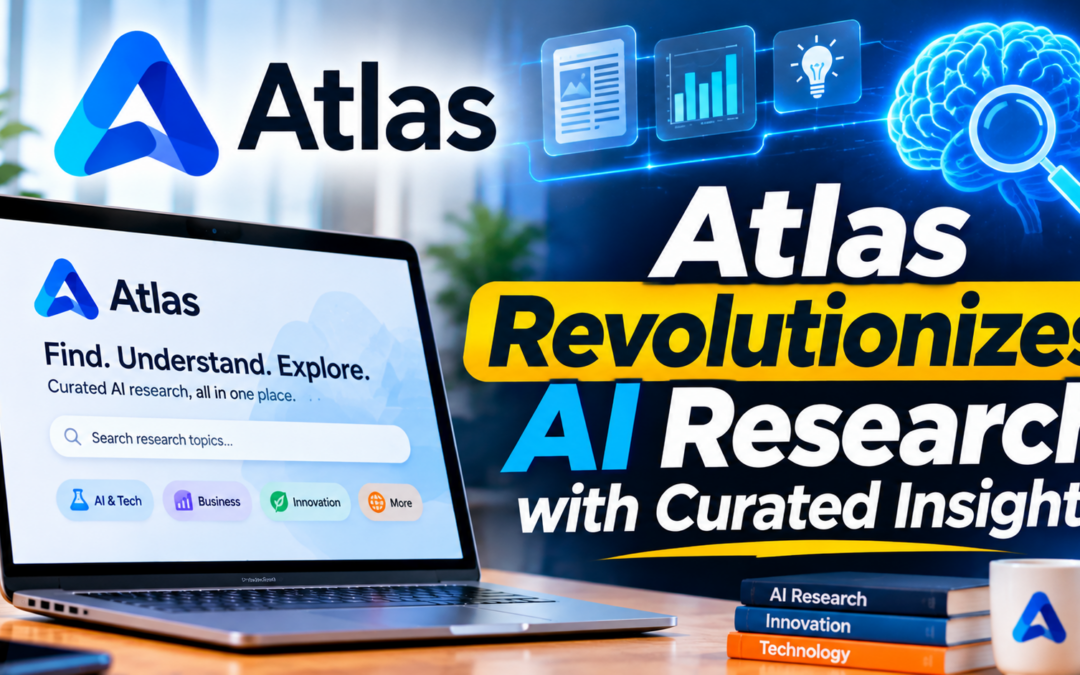
Atlas, the new AI research platform from WorldLabs, enters a landscape hungry for reliable tools that bridge the gap between raw papers and actionable insight. With the tidal wave of generative AI and LLM research flooding arXiv, GitHub, and countless blogs, developers and founders face serious noise-to-signal problems. Atlas aims to fix that, promising curated research, interactive charts, and community-led evaluations—just as the stakes for separating hype from substance reach a new peak.
- Atlas aggregates, categorizes, and evaluates generative AI and LLM research in real time.
- Community-driven scoring helps users identify impactful models and papers, faster.
- Interactive visualizations reveal trends and benchmark data rarely visible elsewhere.
- This approach targets “AI research FOMO” that plagues devs and founders in a fast-moving field.
- Direct links to code, datasets, and demos close the gap between theory and implementation.
Key Takeaways: Atlas Signals a New Era of AI Research Navigation
Developers, founders, and AI specialists all suffer from information overload. Atlas doesn’t just refine search; it structures and interprets the ever-expanding landscape of LLMs, multimodal models, and generative frameworks. Early feedback and feature insights suggest Atlas will accelerate implementation, teaching, hiring, and collaboration in ways that conventional browsing can’t match.
“When raw research outpaces even the most committed reader, tools that sort, rank, and visualize AI breakthroughs become essential infrastructure.”
The Acute Problem: Drowning in AI Research
Since mid-2022, the pace of LLM research has exploded. On arXiv alone, new AI papers arrive daily and code repositories for frameworks like Mistral, Gemma, and GPT-4o appear nearly overnight. Signal gets buried in noise. Most developers spend hours scanning multiple sources, often missing crucial projects or interpretive context needed for decision-making. Atlas responds by creating a real-time, living map of the field, routing past the static lists offered by many incumbent aggregators.
“Atlas doesn’t just index papers; it adds the context—benchmarks, upvotes, code links—builders actually need.”
How Atlas Works: Features for the AI Community
Curated Research Streams
Atlas tracks trending LLMs, multimodal models, evaluation benchmarks, and datasets. Each entry includes critical metadata: institution, release date, and direct links to source code, dataset downloads, and demo apps. Research is categorized across dozens of tags: from ‘Synthetic Data’ to ‘Quantization’ and ‘Model Alignment,’ making deep dives more targeted.
Interactive Leaderboards and Benchmark Visualizations
Users can visualize how foundation models like Claude, Llama, and Sora measure against each other on key metrics, such as MMLU or HellaSwag. Filtering options unpack which models outperform others for specific tasks, underlying architectures, or hardware requirements—a crucial need for applied AI teams.
“By making trends and outliers visible with data-rich diagrams, Atlas helps product teams and researchers spot not just what’s new, but what’s working.”
Community-Led Scoring and Annotations
Atlas incorporates a community voting model, so research isn’t just sorted by recency or citations but also by peer relevance. Discussions, annotations, and quality scoring add critical human judgment, surfacing genuinely valuable advances. This helps teams avoid dead-ends and repetitive rabbit holes.
Why This Matters for Developers and Startups
For startups racing to implement, every week counts. Atlas’s live data and curated resources shorten the path from academic finding to prototype. Embedded links to codebases or Colab examples let engineers go from reading to testing in clicks. For technical founders pitching differentiators to VCs, Atlas’s charts and trend analyses provide raw competitive intelligence.
“Startups can’t afford to wait months for literature reviews—Atlas collapses discovery time from hours to minutes.”
AI educators and hiring managers also benefit: courses and candidate evaluations increasingly demand up-to-the-minute awareness. Atlas’s annotated collections and scorecards are designed to plug directly into onboarding docs and technical interviews, raising the bar for team literacy.
A Broader Shift: The Community-Driven Research Layer
Atlas enters a space where competitors like Paperswithcode and arXiv Sanity offer valuable search and catalog services. What differentiates Atlas is its commitment to interactivity, user-driven ranking, and toolbox approach—bridging theory and practice.
Recent VC attention to open-source LLM evaluation frameworks and meta-aggregators suggests growing recognition: the overload problem is now a bottleneck for global AI innovation. Atlas’s collaborative layer could well become the reference point for AI builders needing instant orientation in an ever-expanding research ecosystem.
What Comes Next for AI Research Platforms?
Expect Atlas to evolve: deeper integration with academic APIs, more advanced semantic search, and increased weight on real-world usage signals over citation count. As LLMs continue to reshape fields from code generation to creative search, the platforms that turn research overload into navigable knowledge will set the new pace for innovation. Developers and founders can anticipate a future where the best research isn’t just accessible—it’s actionable, ranked, and ready to build on.
Source: WorldLabs