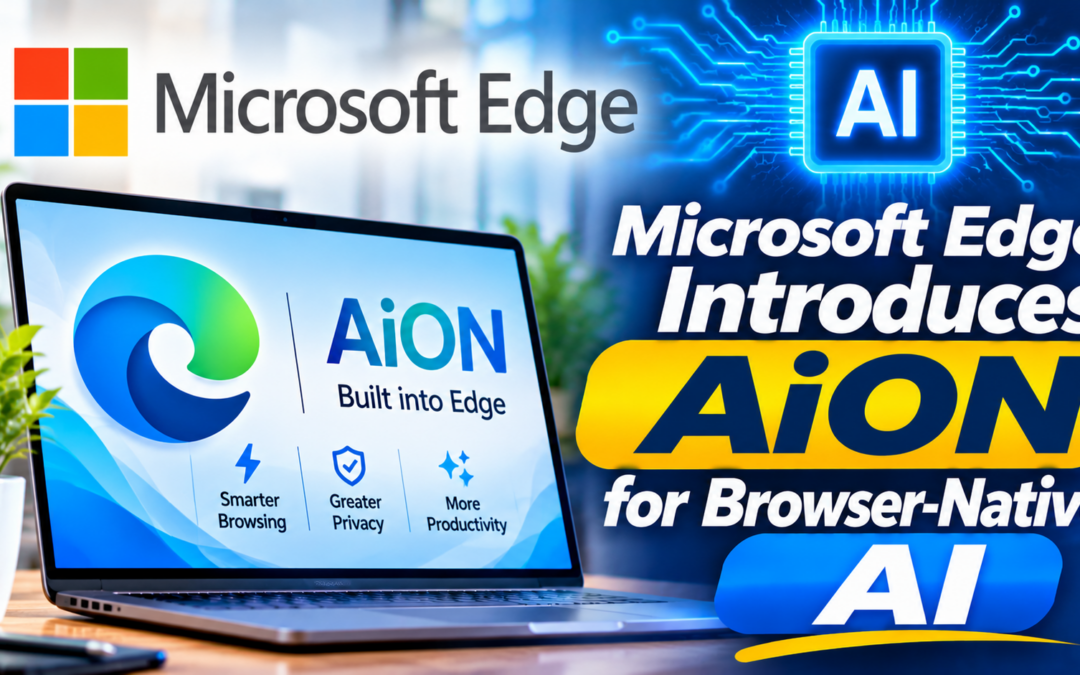
Microsoft’s latest move in the AI arms race aims to put generative intelligence directly in the hands of web developers—right at the browser layer. By introducing AiON Instruct and Prompt API in Edge, Microsoft signals a major strategic shift: developers no longer have to call out to remote APIs to harness large language models (LLMs) or build hybrid-AI tasks. Instead, key AI capabilities are becoming native to the browser itself. The implications for privacy, latency, and innovation are significant—especially as the line blurs between local and cloud-based AI workflows.
- Microsoft Edge launches AiON Instruct and Prompt API, bringing hybrid-AI to the browser
- Developers can run LLM tasks locally, in the cloud, or combine both for seamless experiences
- New APIs enable privacy-first, low-latency generative AI use cases without external dependencies
- This shift accelerates the creation of AI-powered web apps and extensions for both consumer and enterprise markets
Key Takeaways
The introduction of AiON Instruct and Prompt API within Microsoft Edge represents a pivotal transformation for AI applications in web environments. Developers gain granular control over where and how AI workloads execute, enabling both powerful privacy features and lower latency by keeping more activity local. As generative AI becomes a native browser capability, the barrier to entry for innovative new tools and extensions drops significantly.
“For developers, browser-native AI unlocks a new class of secure, real-time applications that were previously limited by data exposure or cloud dependency.”
What Is AiON? Microsoft’s New Hybrid-AI Layer Explained
AiON is Microsoft’s new hybrid intelligence subsystem for Edge. At its core, AiON lets developers declaratively specify where LLMs execute—whether on a user’s device, in the cloud, or dynamically split between both. AiON Instruct and Prompt API act as the interface for prompting, instructing, and managing AI tasks from within web pages or browser extensions—no need for dedicated backends or complicated API orchestration.
With this approach, real-time applications like on-page summarization, context-aware search, and local content generation become possible—and far more performant. Crucially, tasks that require sensitive data never need to leave the device, allowing for privacy-focused generative AI scenarios.
“Hybrid-AI at the browser layer enables developers to optimize for privacy, speed, and user trust—without forcing tradeoffs.”
How Developers Can Leverage The New APIs
The AiON Prompt API provides a standardized, secure way for developers to inject prompts and receive LLM-powered responses from inside any web app or extension. AiON Instruct goes further, allowing developers to define specific jobs, chain instructions, and delegate complex tasks to the most optimal environment—be it local or in the cloud.
For example, an enterprise tool can summarize sensitive internal documents locally, while still leveraging the cloud for non-sensitive, high-compute tasks. This combinatory flexibility wasn’t available before in any mainstream browser—and certainly not at this level of abstraction and security.
“By baking AI runtime logic into Edge, Microsoft is positioning its browser as a foundational development platform for the next generation of AI-centric web apps.”
Industry Implications: Accelerating AI-Powered Web Apps
Traditional AI integration on the web often required juggling external API calls, data compliance, and privacy headaches—creating friction for both startups and enterprise teams. AiON’s hybrid execution model democratizes access to LLM power, whether building consumer chat extensions, productivity boosters, or vertical-specific tooling.
This move puts pressure on rival browsers and developer ecosystems to match Edge’s early lead in native AI support. Mozilla has already announced similar ambitions with its Servo browser AI layer, but Microsoft’s reach and Windows integration give Edge an immediate distribution advantage, especially in businesses seeking privacy-first AI solutions.
“Expect a wave of AI-driven extensions, tools, and services that leverage browser-native LLMs—making privacy and personalization a baseline rather than an afterthought.”
Potential Challenges and Considerations
While hybrid-AI in the browser offers transformative potential, it raises several open questions. Ensuring that local models remain sufficiently updated to avoid hallucination or obsolescence will require novel update architectures. Security researchers will scrutinize model execution pathways for new attack vectors or privacy leaks. For developers, staying up-to-date with evolving APIs and performance tradeoffs will be crucial as the ecosystem matures.
The Road Ahead: Shifting Paradigms in Web AI
With AiON Instruct and Prompt API, the browser has begun its evolution from a passive interface to an active, intelligent platform. For the AI industry, this signals a step toward ubiquitous, privacy-centric web intelligence—one that both consumers and enterprise IT can fully trust. Expect other browser makers to accelerate their AI roadmaps in response, and for the boundaries of web and native AI apps to blur even further.
Source: Windows Blog