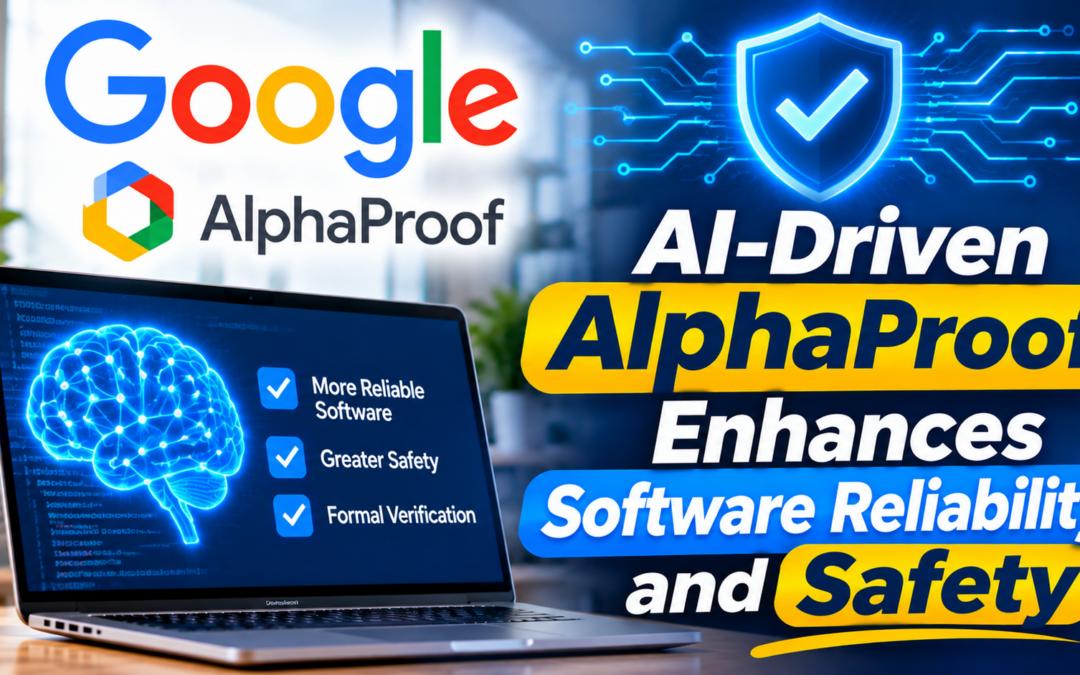
Generative AI is accelerating the pace of code innovation, but it is also heightening concerns about software reliability in increasingly complex systems. Google DeepMind’s new AlphaProof tool aims to reshape how large language models (LLMs) interact with code, marrying rapid development with automated mathematical proof generation. For developers, startups, and AI professionals, AlphaProof signals a pivotal step in the evolution of AI-assisted programming and mission-critical software assurance.
- AlphaProof automates formal code verification using an LLM-driven approach.
- It promises to catch high-impact bugs and security flaws at the code reasoning stage, not just during deployment.
- DeepMind’s solution addresses the absence of rigorous proofs in LLM-generated code, bridging AI innovation and industry reliability needs.
- Broader adoption could redefine trusted software development across sectors—especially finance, infrastructure, and defense.
Key Takeaways
AlphaProof brings LLMs into the realm of formal verification—a domain essential for building dependable and secure applications. This fusion addresses the toughest barrier in AI-assisted programming: ensuring generated code is not only functional but provably correct. The technology leverages a language model specifically trained to reason about code at a mathematical level, not just natural-language logic. AlphaProof has demonstrated success in verifying hundreds of open-source code snippets, including real-world systems previously out of reach for automation.
“AlphaProof signals a new era for AI in software engineering, where the boundary between rapid prototyping and industrial-strength reliability begins to dissolve.”
LLMs Take Aim at Formal Code Proofs
The challenge of formally verifying program correctness has stymied both academia and industry for years. Traditional formal methods require painstaking human effort, resulting in slow progress and limited adoption outside high-assurance sectors. AlphaProof, by leveraging a transformer-based LLM, tackles tasks that historically demanded extensive manual theorem proving. It accepts code written in a subset of the Lean programming language and produces proofs that can be checked by independent verification tools.
How AlphaProof Works
At its core, AlphaProof predicts logical proof steps needed to verify a code property. Unlike previous attempts which relied heavily on symbolic solvers or manual engineering, AlphaProof learns proof search strategies directly from a curated dataset of existing code proofs. This enables it to automate far more diverse or complex code invariants. According to DeepMind’s research, AlphaProof could successfully prove properties for nearly 80% of a benchmark set of algorithmic problems—substantially outperforming prior state-of-the-art systems.
“By shifting proof search from symbolic to learned reasoning, AlphaProof opens code verification to the same exponential advances seen in generative coding itself.”
Industry Implications: Security, Reliability, and Productivity
The stakes for software correctness are not academic. Undetected bugs in critical code have caused costly outages, security breaches, and even physical system failures. With AI models now generating much of this code, the need for robust verification grows ever more urgent. AlphaProof suggests a path to automated, scalable correctness proofs, even as developers accelerate prototyping cycles with generative AI.
For startups, this means safer releases with fewer catastrophic bugs. For established firms, compliance with safety and security standards becomes more achievable. In sectors like autonomous vehicles, finance, and healthcare—where standards such as ISO 26262 or FDA guidance require rigorous assurance—AlphaProof could streamline certification and boost trust in AI-generated systems.
“The ability to automatically verify code may soon become as fundamental to the software stack as CI/CD pipelines or automated testing.”
Limitations and Next Frontiers
AlphaProof is not a silver bullet. Formal proof requires the code to be structured within a supported language (Lean), and complex real-world systems still challenge today’s models. Coverage of domain-specific programming paradigms or large legacy codebases remains a work in progress. However, DeepMind’s open-sourcing of code and benchmarks will likely spur rapid iteration from the research and developer communities. Competing initiatives like Meta’s LeanDojo and OpenAI’s exploration of code reasoning put pressure on the field to accelerate toward end-to-end verified AI tooling.
The Road Ahead: From R&D to Industry Standard
As LLM-powered code generation tools saturate the market, a shift is underway: value is moving from code synthesis to code assurance. AlphaProof’s debut raises expectations for every generative AI model—no longer is it enough for code to simply run; it must be provably correct. Developers should anticipate a future where automated verification integrates seamlessly into everyday workflows, accelerating both speed and trust in AI’s role within the engineering lifecycle.
“Verification is fast becoming the linchpin of AI-first software development—and AlphaProof proves that automation is catching up with ambition.”
AlphaProof marks a milestone for the convergence of LLMs and formal methods, bringing scalable proof generation closer to practical reality. If industry players embrace and extend these advancements, automated verification could soon underpin critical infrastructure, secure digital finance, and drive a safer, AI-powered future.
Source: DeepMind Blog