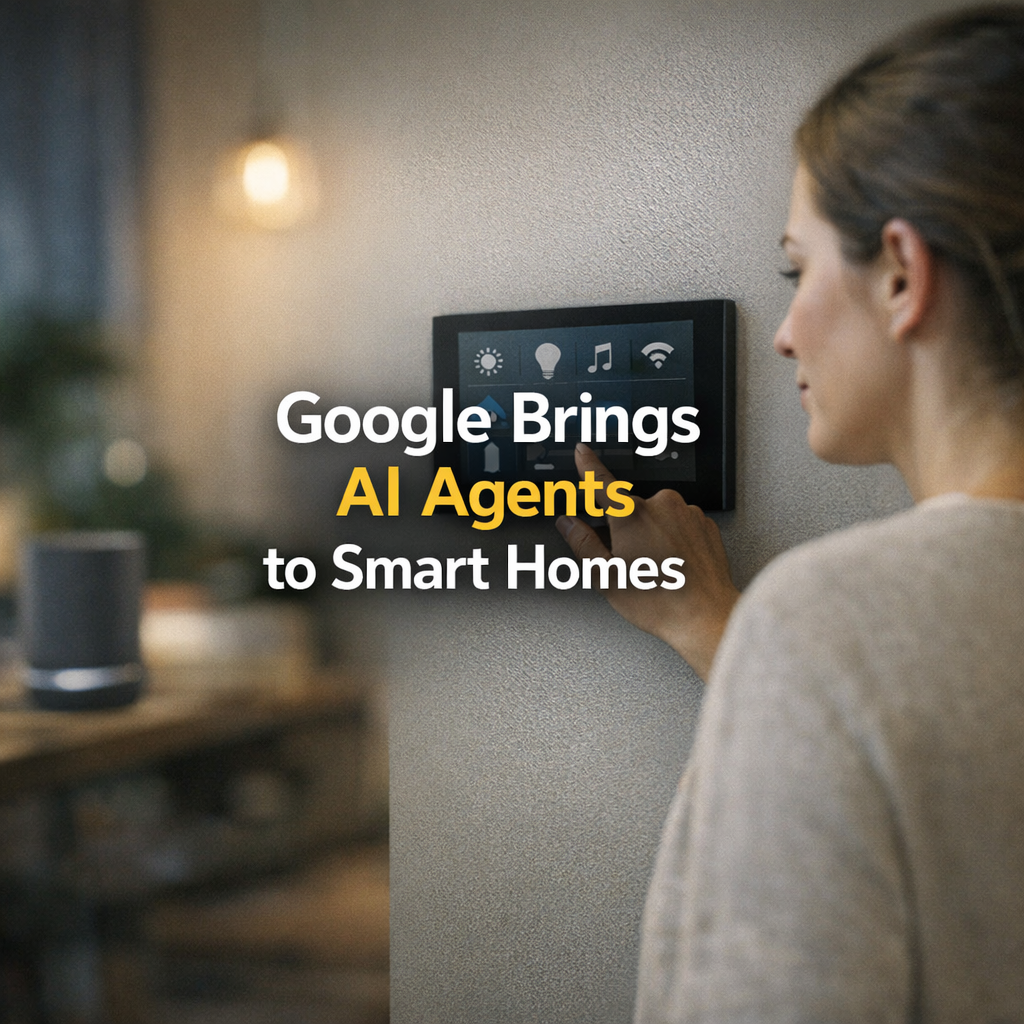
AI agents are rapidly moving beyond digital interfaces and into the real world, gaining the power to control physical environments through smart home integrations. Google’s latest update, which allows third-party AI agents to directly operate Google Home devices, signals a watershed moment for developers and founders pushing the boundaries of generative AI and autonomous systems. This new capability is poised to transform both home automation and the commercial AI ecosystem, opening the door to a new wave of intelligent, multimodal agents with real-world agency.
- Google now permits AI agents to manage Google Home devices, expanding their reach into real-world automation.
- This integration amplifies the potential for LLM-powered agents to execute complex, cross-device tasks with voice, text, or API triggers.
- Developers gain access to new APIs and controls, unlocking business opportunities in smart environments and personalized automation.
- The move escalates privacy, security, and reliability stakes for AI and IoT startups deploying these capabilities.
Key Takeaways: How Google’s Move Reshapes AI and Automation
Allowing AI agents to control Google Home devices dramatically expands the application layer for generative AI. Startups can now build agents that execute tasks across a user’s entire home ecosystem—from lights and thermostats to vacuums and cameras. This evolution positions AI not just as a source of answers or code, but as an orchestrator of physical, everyday actions.
“AI agents that manage real-world devices mark a shift from digital intelligence to physical agency—developers now have tools to turn LLMs into orchestrators of the smart home.”
The significance extends well beyond consumer convenience. For enterprise and B2B developers, these APIs create a foundation for robust, context-aware automation in healthcare, hospitality, property management, and elder care—fields where seamless, hands-free control can add measurable value.
AI Agents in the Home: Moving From Voice Assistants to Autonomous Systems
For years, voice assistants like Assistant, Alexa, and Siri provided only structured, basic command capabilities. The new wave of AI agents, powered by large language models, leapfrogs these limitations by enabling flexible, goal-driven automation. Now, an agent can act on high-level instructions—such as “prepare the house for bedtime”—executing a personalized sequence of actions: dimming lights, locking doors, adjusting temperature, and shutting off appliances.
“The transition from static routines to dynamic, AI-driven automation will redefine users’ expectations of smart home technology.”
Developers can build cross-platform agents that learn from user preferences, handle exceptions, and respond intelligently to context—pushing home automation toward true adaptability.
Developer APIs: Unlocking New Use Cases and Revenue Streams
With Google Home’s API gateway now open, startups and independent creators can deliver novel automations and value-added services. Agents can integrate with scheduling systems, customer support bots, or even enterprise dashboards, using Google Home endpoints as actionable nodes in larger workflows.
Key considerations for developers include:
- Data privacy and permissions: Agents must handle user data and device access securely, requiring robust authentication and sandboxing.
- Reliability and failover: Real-world device control introduces new risks; developers need guardrails, confirmations, and error handling to prevent unwanted actions.
- Monetization: Opportunities abound in subscription services, premium integrations, and vertical-specific solutions that transform smart home access into recurring revenue.
Security and Ethics: Raising the Stakes for Consumer Trust
As AI agents gain real-world powers, the risk profile shifts. A compromised or malfunctioning bot could unlock doors or disable security systems. Google’s rollout emphasizes granular permissions and strict API governance. Industry observers expect an increase in penetration tests, user education, and third-party auditing tools.
“Empowering generative AI agents to operate physical devices heightens the need for transparency, consent, and airtight cybersecurity.”
Enterprises and startups working with these new APIs must adopt a zero-trust mindset—restricting what agents can initiate, monitoring for anomalies, and communicating clearly with users about autonomy and override options.
Broader Ecosystem Impacts: Signal for Platform Wars
By opening up smart device control to third-party AI agents, Google fires the starting gun on an ecosystem arms race. Amazon, Apple, and Samsung are likely to accelerate their own agent integrations and partnerships with LLM providers. Interoperability and standardization remain hotly contested; the companies that can offer both the richest automations and the safest controls stand to capture developer mindshare.
“The companies that best marry AI autonomy with user safety will set the standards for tomorrow’s connected environments.”
For the developer community, this moment calls for upskilling, open-source tooling, and aggressive experimentation to shape what agent-driven automation looks like at scale.
Conclusion: The Path Toward Autonomous Environments
Google’s expansion of AI agent control over Google Home devices marks a decisive step toward autonomous, intelligent spaces. This move empowers a new generation of LLM-powered applications that blur the line between digital intelligence and real-world action. Startups and platforms willing to invest in security, trust, and seamless automation will unlock immense value for businesses and consumers alike as this paradigm accelerates.
Source: TechCrunch