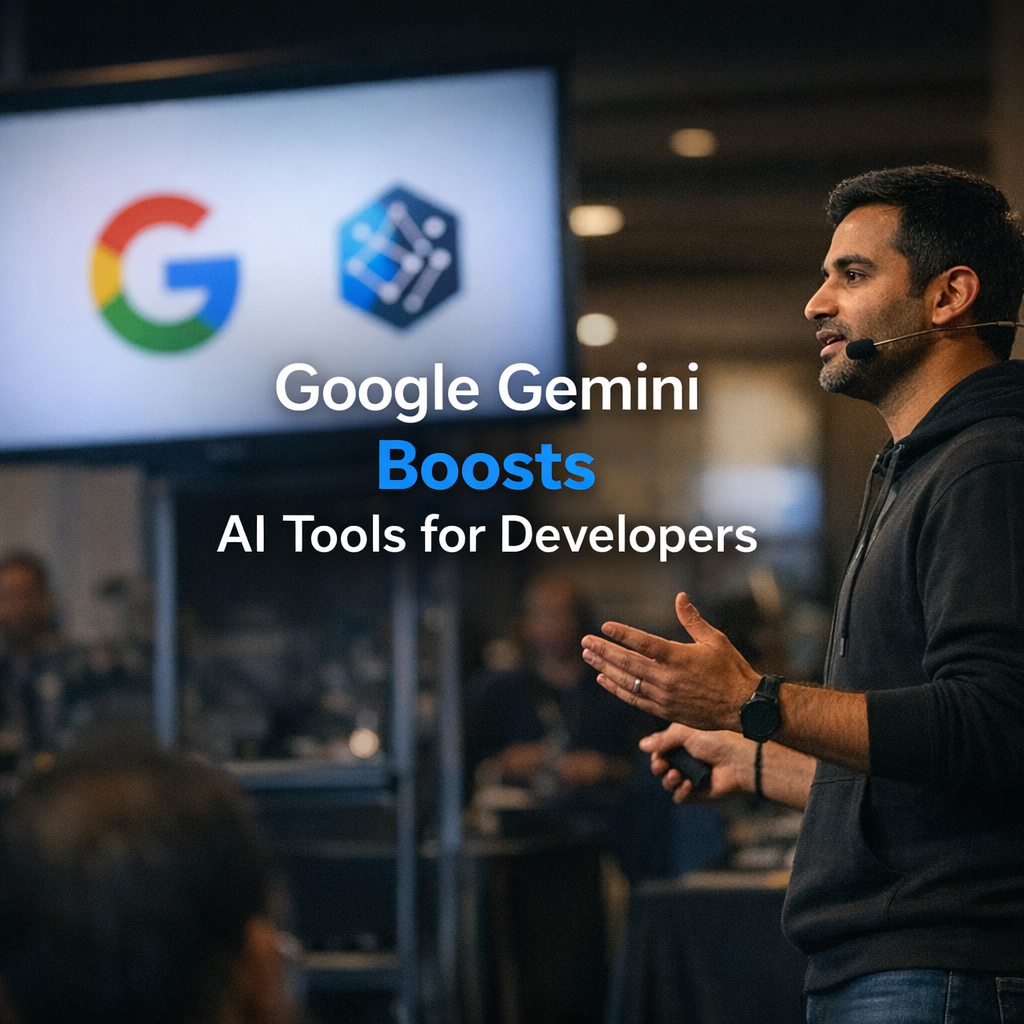
AI innovation continues to accelerate as Google announces Gemini 3.7 Flash, a new lightweight large language model (LLM) engineered for speed, scale, and real-time response. In a market where latency and cost challenge both startups and enterprises, Gemini 3.7 Flash aims to redefine the tradeoff between performance and efficiency in generative AI applications. The introduction of customizable Gemini models, coupled with upgrades to Google’s AI Studio and Vertex AI, reshapes the landscape for developers building multi-modal, high-volume, and interactive AI solutions.
- Google unveils Gemini 3.7 Flash: a fast, cost-efficient LLM tailored for large-scale use cases.
- Custom Gemini models and APIs debut, enabling businesses to fine-tune generative AI for proprietary needs.
- Upgrades to AI Studio and Vertex AI strengthen developer operations and simplify multi-modal workflows.
- Competitive pricing and performance position Gemini models against OpenAI GPT-4o and Claude 3.
- Broader ecosystem integrations signal a new era of specialized AI products at scale.
Key Takeaways
Google’s strategic push with Gemini 3.7 Flash and ecosystem enhancements underscores several pivotal trends. The increasing demand for lightweight, high-throughput LLMs drives model innovation beyond pure accuracy benchmarks. For developers, fine-tuning and model customization become standard expectations, not advanced perks. Enterprises now seek domain-specific deployments at scale, with strong ROI incentives to migrate workloads from general-purpose APIs. The race to lower cost-per-token and system latency—from Google, OpenAI, and Anthropic—is rapidly shrinking the gap between real-world user expectations and generative model performance.
“Google’s move to optimize for speed and affordable inference marks a turning point: generative AI tools are no longer reserved for heavyweight tasks—they’re primed for mass adoption in everyday applications.”
Gemini 3.7 Flash: Performance and Cost as Differentiators
Gemini 3.7 Flash, now available in public preview via Google AI Studio and Vertex AI, is engineered for rapid, scalable deployment. Leveraging advances in model distillation and efficient architecture choices, Flash serves high-throughput workloads such as summarization, chatbots, search augmentation, and video captioning. It supports a 1 million-token context window—matching its sibling Gemini 3.7 Pro—but delivers significantly reduced latency and computation costs. Early benchmarks indicate that while Flash trails slightly behind Pro in reasoning and complex generation, it outpaces previous Gemini iterations in response time and API rate limits, making it especially attractive for interactive applications and mobile integration.
“With Gemini 3.7 Flash, developers can now serve millions of low-latency API calls per day without the cost blowout typical of flagship LLMs.”
Custom Models and Developer Tooling: Flexibility First
Alongside Gemini Flash, Google introduces “Gemini Custom”—a set of APIs and workflows allowing enterprises to specialize Gemini models using proprietary datasets, RAG (retrieval augmented generation) techniques, and advanced fine-tuning. This capability supports industry use cases from healthcare to financial analysis, enabling stricter compliance, brand voice adaptation, and knowledge base integration. Google AI Studio and Vertex AI see expanded support for model evaluation, experiment tracking, and dataset management, echoing features from OpenAI’s GPTs and Anthropic’s Claude Workbench, but emphasizing open APIs and managed deployment on Google Cloud. Integrations with Workspace apps, security controls, and output monitoring put developer experience front and center.
“Customizable AI is quickly becoming a baseline requirement—Google’s tools now provide the scaffolding for organizations to build, refine, and monitor secure domain-specific AI at enterprise scale.”
The Competitive Landscape: LLMs for the Real World
The release of Gemini 3.7 Flash intensifies competition with GPT-4o and Claude 3. Recent independent testing (from sources such as Ars Technica and TechCrunch) shows Gemini 3.7 Flash’s performance on par with peers for high-volume, transactional tasks—while cost advantages may be decisive for startups eyeing profitability. Google’s shift toward multi-modal capability (text, vision, audio), plus its public benchmarks on competitive leaderboards (MMLU, MedMCQA), signal a transition: generative models must prove value not just in benchmarks, but in production latency, output safety, and integration depth.
For product teams, the ability to deploy models with sub-500ms response times, customizable guardrails, and end-to-end workflow support differentiates platforms. Early partners report smoother integration in video processing, code review, and automated customer service, areas where inference speed previously blocked scale. Google’s open ecosystem, paired with Vertex AI’s global infrastructure, invites startups and established players to iterate faster and deploy at lower operational risk.
Practical Implications for Developers and Startups
Developers building with Gemini 3.7 Flash gain access to context windows matching the largest on the market, flexible APIs, and competitive pricing suited for mass-market tools. Real-world adoption will likely accelerate in:
- Conversational AI—low-latency chatbots, live translation, and multi-modal digital assistants.
- Video and document summarization—business intelligence from large unstructured datasets.
- Knowledge integration and custom search—domain-tuned LLMs for finance, law, and healthcare.
Startups in particular can prototype rapidly and scale users without immediate concern for prohibitive token costs or hosting burdens. Vertex AI’s “serverless LLM” offering eliminates DevOps overhead, letting small teams focus on user experience and domain-specific innovation. Early access to model customization and RAG pipelines lowers the barrier for competitive differentiation, a critical edge in crowded generative AI verticals.
“Speed, cost-control, and developer flexibility have graduated from nice-to-haves to essential features—any AI platform competing in 2024 must deliver on all three fronts to stay relevant.”
Industry Outlook: What’s Next for Generative AI Builders?
Google’s Gemini 3.7 Flash and the accompanying custom AI toolkits usher in a new phase of accessible, scalable generative AI. As the differentiation between ‘big’ and ‘fast’ models blurs, the industry converges on a future where prompt responsiveness, operational efficiency, and bespoke model tuning define the next wave of AI adoption. Platform wars will pivot increasingly toward developer experience, open integration, and production-grade governance. For AI teams, these advancements mean reduced time-to-market, cheaper experimentation, and the prospect of domain-adapted intelligence at scale—unlocking new frontiers across industries.
Source: Google Blog