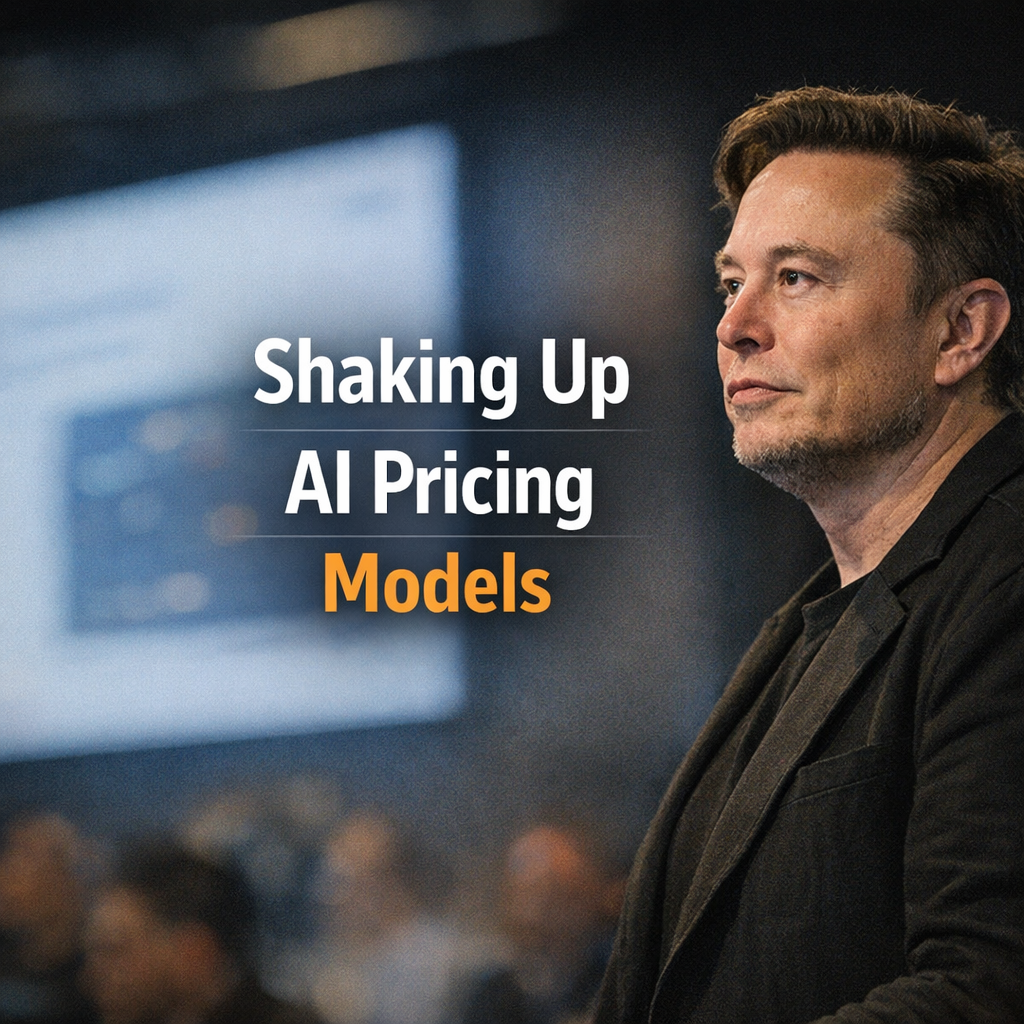
Can a new challenger shake up the AI model marketplace, redefining what developers and startups expect from foundation models and their pricing? xAI, Elon Musk’s AI venture, has just released Grok-1.5V, its latest large language model (LLM), alongside Grok-47—an even more powerful iteration—available on the vLLM model repository at a headline-grabbing $26 per million tokens. These bold moves set the stage for a pivotal moment as generative AI races ahead in capability, accessibility, and scale.
- Grok-47 arrives on vLLM with aggressive pricing, aiming to undercut established LLM competitors.
- xAI’s release raises the stakes for open-source and commercial foundation model innovation.
- Developers gain faster inference speeds and bigger context windows, directly lowering build costs.
- Industry observers see new pressure on OpenAI, Google, and Anthropic to revisit pricing and feature sets.
Key Takeaways
xAI’s Grok-47 drop is not just another LLM release—it’s a strategic salvo at the commercial AI establishment. At $26 per million tokens, xAI signals clear intent to make high-performance generative AI dramatically more affordable for large-scale applications. Both Grok-1.5V and Grok-47 tout expanded context windows, sharper mulitmodal capabilities, and increased efficiency for real-world deployment. For startups and enterprise AI teams, these advancements mean a lower barrier to experimentation—and likely, faster iteration cycles.
“Aggressive pricing and technical leaps by xAI threaten to redefine cost, capability, and competition for LLM-powered products worldwide.”
xAI’s Bet: High Performance, Low Price
xAI’s Grok-47 leapfrogs numerous rivals with its release on vLLM, the open-source serving framework renowned for efficient distributed inference. At $26 per million tokens, Grok-47 undercuts Llama-2, Mixtral, and proprietary models from OpenAI and Google, whose token pricing frequently sits 3–4x higher. For AI developers running production workloads, this translates directly into cost savings—enabling higher throughput, richer chatbots, and more affordable RAG (retrieval-augmented generation) solutions.
“Price compression on industrial-scale LLMs reopens the field for innovative startups—not just Big Tech.”
Technical Gains: Context, Speed, and Versatility
With the launch of Grok-1.5V and Grok-47, xAI delivers both larger context windows and advanced multimodal inputs. Grok-1.5V supports up to 128,000 tokens, crucial for document-heavy or sequential reasoning tasks. The models also deliver turbocharged throughput on vLLM, with inference rates showing 2–3x improvements versus previous versions according to lab benchmarks discussed across developer forums and technical breakdowns.
xAI positions Grok not just as a chatbot, but as a viable engine for knowledge extraction, summarization, and complex code generation. The models’ improved “sweeping” capabilities, noted on developer boards and validated in community-run performance tests, point toward leaner applications that can parse documents, emails, and tables with near-human comprehension speeds. Early adopters have reported promising results integrating Grok into backend document QA, data cleaning, and research workflows.
Competitive Shockwaves in the LLM Ecosystem
xAI’s release intensifies the competitive pressure on OpenAI (whose GPT-4o model remains considerably pricier), Google (with Gemini Pro), and Anthropic (Claude 3). These incumbents must now justify higher token costs with either significant capability jumps or risk rapid commoditization of their APIs. Meanwhile, Meta’s Llama-3 seeks to offer open-access models with fast weights and 8K context, but Grok-47’s pricing and context window leap ahead in a crucial deployment axis for cloud and SaaS buildouts.
“The generative AI arms race now pivots on how fast, cheap, and adaptable LLMs can get, not just their headline benchmarks.”
Implications for Startups and Enterprise Teams
CIOs and AI leads have often hesitated to deploy LLM-driven automation at scale due to spiraling API costs, especially for high-interaction apps or analytics-heavy features. Grok-47’s pricing slashes this barrier, enabling teams to push more inference to production without the looming cloud bill. For toolmakers and SaaS startups, lowered token costs widen the competitive moat and let builders iterate or experiment faster—key to winning in a maturing market.
Further, the availability of Grok-47 on vLLM aligns with developer workflows seeking maximum deployment flexibility—from on-prem clusters to cloud-native environments. Those building custom copilots, knowledge management bots, or search engines can now slot Grok-47 into their stacks without vendor lock-in or prohibitive spend.
What’s Next for the AI Model Market?
The release of Grok-47 at such a competitive price marks a turning point: price and efficiency, not just “who is the smartest model,” are now core differentiators in LLM adoption. Expect a wave of announcements and counter-offers from other AI vendors in response, as both established providers and open-source projects race to deliver value for builders at scale. For developers and founders, the practical implications are immediate: more affordable, high-performance generative AI is no longer a distant promise, but the new standard for what’s possible in 2024.
Source: AI Weekly