What if AI could run anywhere, on any device, with real privacy and lightning-fast response? This vision drives PrismML’s new lightweight LLM, reshaping expectations for where and how generative AI can be used. With the AI landscape racing toward ever-larger models, PrismML takes a contrarian path: shrinking the AI footprint while boosting speed and accessibility, and promising to shift the battle for LLM dominance in 2024 and beyond.
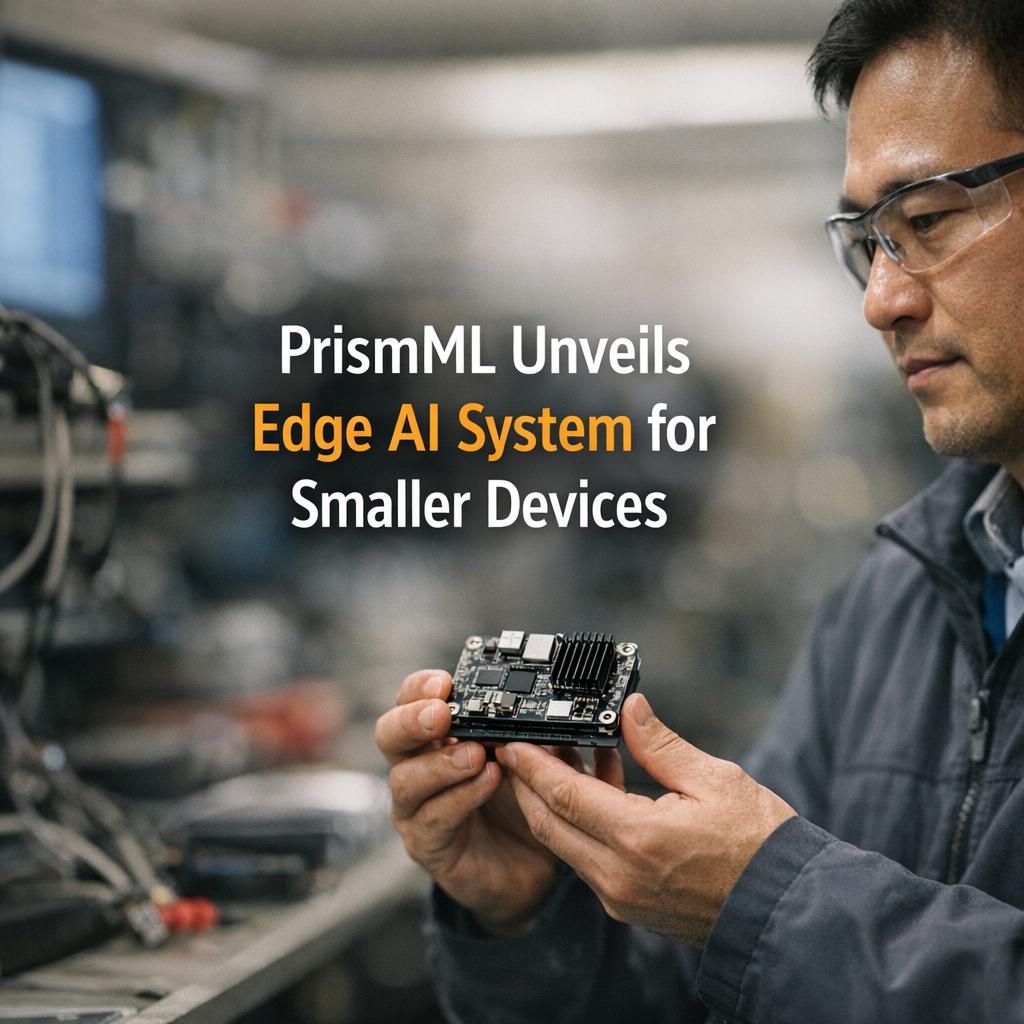
- PrismML unveils a tiny LLM optimized for edge and on-device AI use.
- Breakthroughs in model compression and quantization drive competitive performance at a fraction of big-model resource demands.
- Startups and developers gain new freedom to deploy AI locally, reducing cloud dependence and enhancing privacy.
- Early benchmarks show the miniature model rivals giants like Llama 3 and Gemini Nano—while running smoothly on consumer hardware.
Key Takeaways: PrismML’s Mini LLM Disrupts Conventional AI Thinking
Recent advances have revolved around massive LLMs, with the likes of OpenAI’s GPT-4o and Google’s Gemini setting new records. In contrast, PrismML’s “tiny LLM” offers an alternative: comparable functionality on smaller hardware, unlocking new applications in embedded systems, smartphones, and even browsers. The technology enables:
- Local inference for low-latency, high-speed interactions without internet reliance.
- Enhanced privacy, as user data never leaves the device during inference.
- Wider accessibility to AI for developers targeting resource-constrained or offline environments.
“By shrinking LLMs to fit in the palm of your hand, PrismML isn’t just doing more with less—they’re rewriting what edge computing means for AI.”
The Technical Leap: Achieving AI at the Edge
PrismML’s engineering hinges on sophisticated model compression and quantization. The company reports models as small as 1GB, a stark contrast to GPT-4o’s 1.8 trillion parameters. By leveraging sparsity, weight pruning, and efficient tokenization, PrismML achieves sub-second response times on standard devices—including recent mobile phones and laptops.
“Model efficiency is the new frontier for AI—tiny LLMs lower the barrier for worldwide adoption and radically expand developer playbooks.”
While competitors such as Apple and Google have introduced smaller, device-ready models like Gemma and Gemini Nano, PrismML claims a unique balance: top-tier accuracy without ballooning compute load. According to public GitHub repos and recent Hacker News discussions, developers can run PrismML’s models in-browser or with minimal hardware acceleration—making this LLM attractive for rapid prototyping, IoT, and sensitive enterprise deployments.
Why Local AI Matters: Privacy and Power for Developers
Deploying AI models directly on devices yields tangible advantages. Applications become less dependent on cloud APIs, resulting in:
- Reduced operational costs by minimizing cloud inference calls.
- Greater resilience and reliability for mission-critical or offline applications.
- Stronger privacy controls—crucial for fields like healthcare, finance, and personal productivity.
With PrismML’s toolkit, startups and independent developers can fine-tune or use pre-trained models tailored for on-device workloads. This flexibility is critical as edge AI and federated learning gain traction in IoT, AR/VR, and next-generation mobile experiences.
“Decentralizing AI with efficient LLMs puts innovation in the hands of millions, far beyond the reach of cloud giants.”
Competitive Dynamics: Where PrismML Sits Amid Giants
While industry leaders pour resources into scaling up foundation models, demand for compact, nimble LLMs is exploding. Facebook’s Llama 3 and Google’s Gemini have launched smaller variants, but early technical testers suggest PrismML’s models run faster and often match benchmark accuracy—all on regular ARM or x86 devices. This dynamic appeals not only to cost-conscious startups, but also to global markets with bandwidth or sovereignty concerns.
PrismML’s recent partner pilots include fintechs deploying on-premise chatbots and healthtech firms integrating clinical note summarization via embedded AI—validating the hunger for privacy-forward, local LLMs outside the hyperscaler universe.
Looking Ahead: The Future of AI May Be Tiny
PrismML’s announcement heats up the race for practical, user-first AI—one that puts intelligent models inside devices people already own. If tiny LLMs can balance performance with privacy and speed, the traditional reliance on cloud AI may erode across industries. Expect to see developers experiment with edge-focused workflows, new privacy-centric apps, and an influx of startups capitalizing on AI made truly portable.
This new wave in miniaturized LLMs may redefine AI deployment strategies, pushing the boundaries of what is possible on personal and enterprise devices—and forcing even the biggest AI players to rethink their roadmap.
Source: TechCrunch