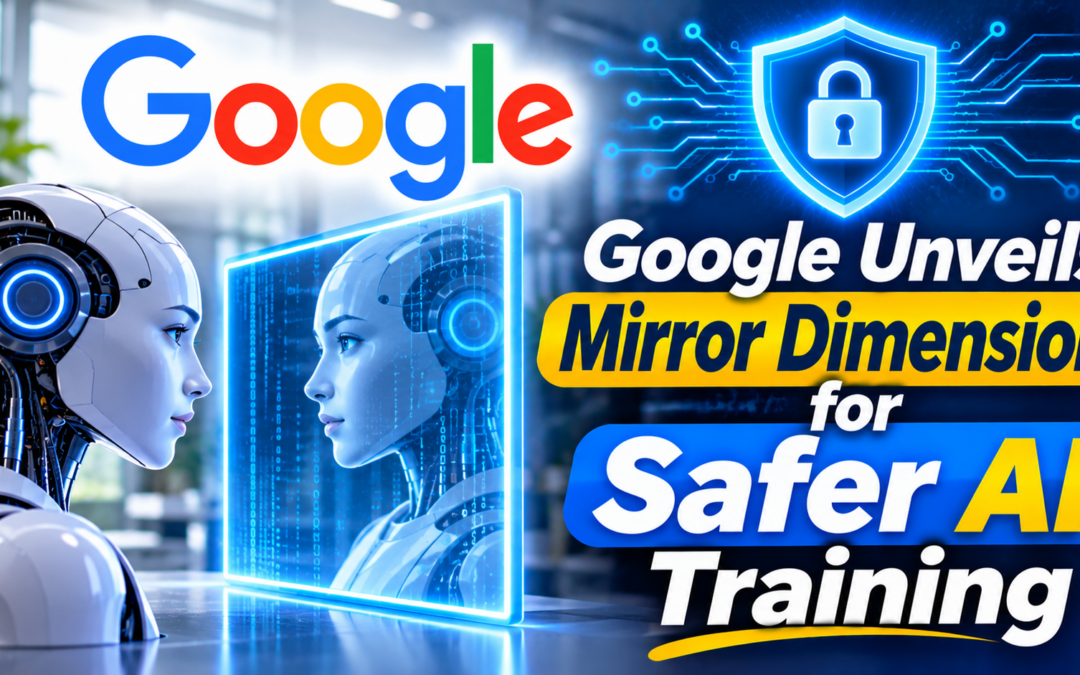
Could AI agents soon learn and adapt within vast simulated worlds before ever interacting with real systems? Google has unveiled a “mirror dimension” for large language model agents, setting the stage for a new era of scalable, safe, and rich AI training environments. As generative AI enters high-stakes domains, the pressure mounts to ensure these systems behave reliably in unpredictable, real-world situations—a challenge now tackled with a strategy inspired by video game simulations and digital twins.
- Google introduces a large-scale virtual sandbox for AI agents to train safely and repeatedly.
- Emulates real-world apps, services, and scenarios for code evaluation and interactive reasoning.
- Promises faster, safer agent development and a dramatic leap in LLM agent reliability.
- Signals a shift toward continuous, environment-driven AI learning—mirroring trends in robotics and self-driving.
Key Takeaways: Next-Level AI Training Through ‘Mirror Dimension’
Google’s mirror dimension project heralds a crucial shift: instead of fine-tuning LLMs solely on static data or ad-hoc benchmarks, developers can now immerse agents in persistent, interactive simulations. This accelerates agent improvement, stress-tests behaviors, and helps pinpoint rare failure cases—delivering reliability needed for enterprise and end-user adoption.
“By constructing intricate virtual worlds for large language model agents, Google redefines what’s possible in safe, scalable AI development—preparing agents to navigate real-world complexity before deployment.”
This controlled, reflective environment tackles not just technical debugging, but practical questions of user trust, security, and compliance—factors that now shape adoption in finance, healthcare, customer support, and developer tooling.
Why AI Needs Synthetic Worlds
The leap from LLM text completion to real-world autonomy means agents must handle open-ended instructions, ambiguous user intent, and edge-case interactions. Traditional test suites or conversational sandboxes fall short—particularly as AI drifts from chatbots to task automation, API calls, and intricate workflows across platforms.
“When AI agents must reliably reason, act, and adapt across countless real-world apps, ‘playground’ environments become indispensable—shortcutting years of risky trial-and-error deployment.”
Recent incidents of LLMs misbehaving—generating insecure code, leaking data, or getting stuck in logic loops—underscore the risk. With the mirror dimension, Google applies lessons from the robotics and gaming domains, where simulation-first methodology proved critical for safe progress.
Inside Google’s Mirror Dimension Approach
Google’s virtual environment emulates authentic digital spaces: think cloud apps, document repositories, websites, even codebases. Within this sandbox, AI agents navigate workflows, handle complex prompts, debug code, and face adversarial situations—allowing measurement, iteration, and intervention at scale.
Agents receive not just coded feedback, but tailored metrics on goal achievement, safe behavior, and policy compliance. Developers orchestrate scenarios ranging from benign daily tasks to security-critical threat modeling, tracking agent performance every step.
“In a persistent simulation, agents experience—and learn from—failures without consequence, enabling continuous improvement cycles impossible in noisy real-world systems.”
This mirrors the strategy adopted in cutting-edge autonomous driving, where companies like Waymo simulate millions of driving miles to uncover rare, dangerous edge cases. Google’s new project brings that methodology to the heart of generative AI and LLM-based agents.
Impacts for Developers, Startups, and AI Leaders
The introduction of mirror dimensions transforms how AI-powered products reach production. Developers gain repeatable environments for regression testing and safety analysis. Startups can iterate on agent design without the risk of user-facing outages. Enterprises, especially in high-compliance sectors, see a pathway toward certification and robust validation before greenlighting autonomous agents.
As competitors—from Microsoft’s AutoGen Studio to open-source agent platforms like LangChain—race to deliver safe, customizable AI automation, the bar rises for robust pre-deployment testing. Google’s public research and protocols will influence best practices industry-wide, accelerating platform maturity well beyond single-provider lock-in.
“The shift toward environment-driven agent training means startups can rapidly prototype and harden AI-powered workflows—closing the reliability gap that throttles enterprise adoption.”
Moving Toward Continuous Learning and Safer AI
By closing the feedback loop between simulated experience and agent refinement, Google aims to unlock continuous self-improvement for generative AI. Agents trained in mirror dimensions won’t just perform better on benchmarks; they’ll adapt more rapidly to novel user needs and dynamic business environments. For the broader AI industry, this is a template for ethical, scalable, and future-proof development.
“Mirror dimensions mark a turning point: AI agents can now rehearse their way to safety and capability, sidestepping the risk of learning on real users and sensitive systems.”
What’s Next for AI Agent Safety and Deployment?
Google’s move signals a broader recognition that scaling LLM-based agents demands purpose-built simulation environments—mirroring the evolution of autonomous vehicles and robotics. As this paradigm gains traction, expect standards bodies, cloud vendors, and developer platforms to prioritize agent training frameworks, robust simulation APIs, and continuous environment validation. The path from promising AI demos to trusted, production-ready agents now runs through synthetic worlds.
Source: Google Blog