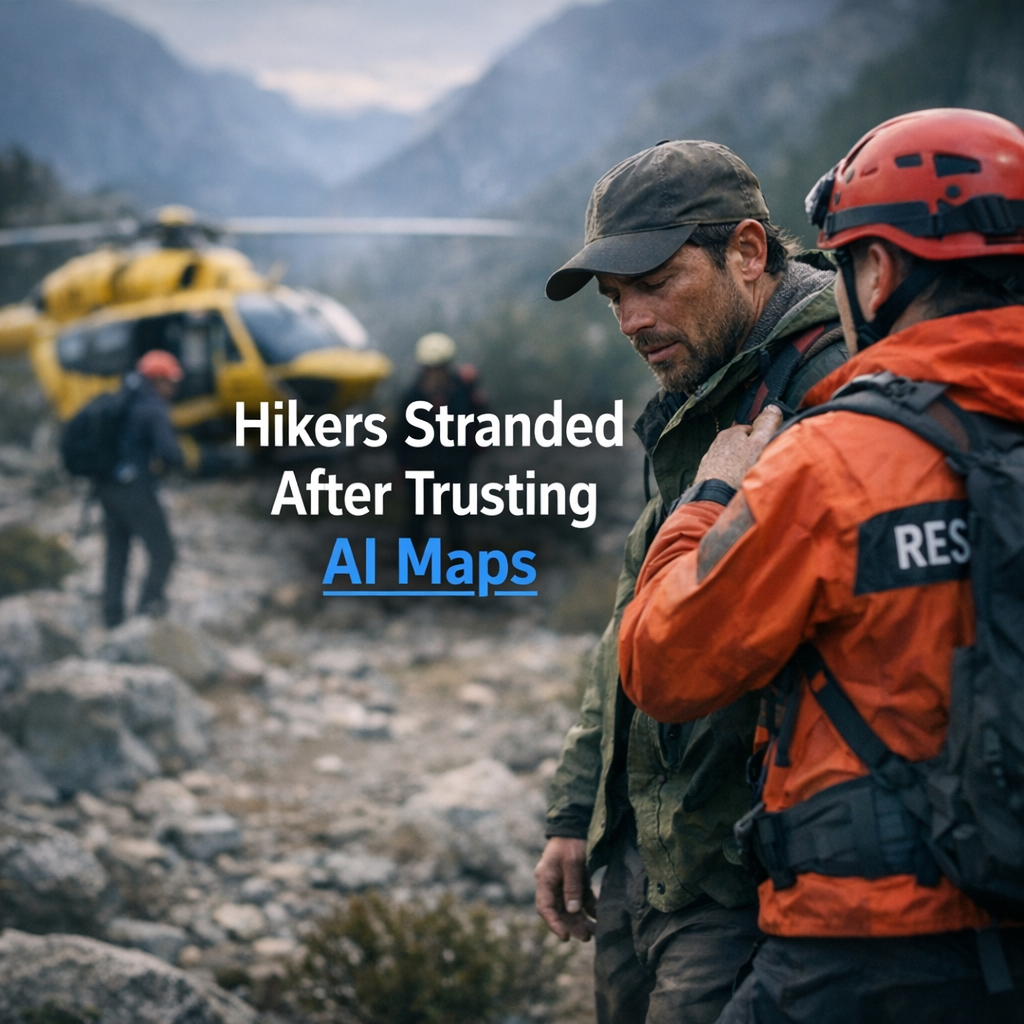
What happens when powerful generative AI tools — designed to assist anyone, anywhere — are trusted with life-or-death situations? That question is front-and-center after a group of hikers was rescued following a mountain trip planned entirely with Google Gemini. As AI rapidly expands beyond chatbots into real-world navigation, travel, and logistics, developers and tech leaders must re-examine the boundaries of trust, safety, and responsibility.
- Hikers rescued after relying on Google Gemini for route planning
- Incident sparks discussion on the limitations and risks of using LLMs for real-world navigation
- Experts urge AI developers to prioritize context, accuracy, and user education
- Event spotlights the emerging need for robust guardrails in generative AI tools
Key Takeaways: When Generative AI Missteps Become Safety Hazards
The Gemini-powered hiking plan led participants onto an unsafe route unsuited for their skill and experience. Search and rescue teams intervened after the group became stranded, exposing the stark gap between generative output and the realities of physical terrain.
Trusting LLMs for real-world decision-making brings profound risks when the AI’s output outpaces its underlying geographic or situational awareness.
Incidents like this highlight why the AI industry must address not just hallucinations, but the practical pitfalls AI can create when its suggestions are taken at face value.
How the Incident Unfolded: The Role of Google Gemini
The group used Google Gemini, an advanced LLM-powered assistant, to generate a detailed multi-day hiking plan. Lured by Gemini’s confident, conversational planning style, the hikers set out without additional human review. Gemini’s plan did not factor in live trail conditions, closures, or recent weather events. When terrain challenges escalated, participants could not proceed safely and required outside help.
This is not the first instance of AI-generated navigation guidance leading to trouble. Earlier this year, national park rangers reported at least two separate incidents where AI-recommended routes conflicted with local advisories or mapped unsafe shortcuts, according to The Washington Post and Adventure Journal. The rapid growth of consumer-facing LLMs in apps from giants like Google and OpenAI is outpacing the integration of real-world safety data.
When LLMs blend outdated or incomplete map datasets with generative ‘confidence,’ the result can be not just inconvenience, but real danger.
Why Generative AI Needs Explicit Safety Guardrails
The Gemini incident turns up the heat on a crucial question: How much responsibility should AI developers assume for outputs that affect user safety? Technical limitations in LLMs — such as limited world knowledge after their training cutoff dates — mean they cannot ensure up-to-date or fully accurate route information.
LLMs cannot substitute for domain-specific knowledge in time-sensitive contexts. Tools like Google Maps, AllTrails, and National Park Service databases are built with layers of real-time alerts and expert curation. By contrast, generative AI’s prose may feign expertise in areas where its data is thin, and chatbots may lack the real-time connectivity to evolving field conditions.
The industry must move beyond disclaimers; AI-generated guidance for high-stakes use cases needs embedded, context-aware safety limitations and dynamic data integrations.
Implications for Developers, Startups, and AI Innovators
This event highlights three essential lessons for AI builders:
- Context matters: LLM outputs should always clarify the limits of their domain expertise, ideally by referencing up-to-data or routing users to validated sources for critical planning.
- User education is essential: Interfaces should flag when data may be outdated, incomplete, or inappropriate for safety-critical decisions.
- Multimodal integration is key: Real-world AI assistants will need direct connections to live data feeds — maps, weather, advisories, and user location — to offer reliable guidance in logistics, travel, or emergency scenarios.
Startups aiming to bridge generative AI with field services must invest heavily in fallback systems and partnership with domain experts, or risk liability and erosion of user trust.
How the Industry Is Responding
In the wake of Gemini’s role in the hiking incident, both technology providers and regulators have quickened efforts to clarify guidelines. Several mapping and navigation app companies now publicly warn against relying solely on AI-generated routes. Meanwhile, AI safety advocates push for clearer transparency prompts inside conversational assistants.
In Europe and the US, regulators have signaled that critical use cases (navigation, medical advice, financial guidance) will face stricter oversight — prompting some platforms to draw boundaries around what their LLMs can answer, or require explicit user consent before offering planning advice in sensitive categories.
If generative AI aspires to become a universal copilot, responsible adoption demands automated checks and user-aware ‘circuit breakers’ baked into every deployment.
What Comes Next for AI, Trust, and Real-World Planning
The hikers’ rescue is not just a cautionary tale — it’s a call to action. As AI assistants move deeper into life’s logistics, software teams must reengineer these tools for situational awareness, transparent limits, and ongoing validation against the real world. The winners in the generative AI space will be those who invest as much in prudent guardrails as in dazzling output.
Source: TechCrunch