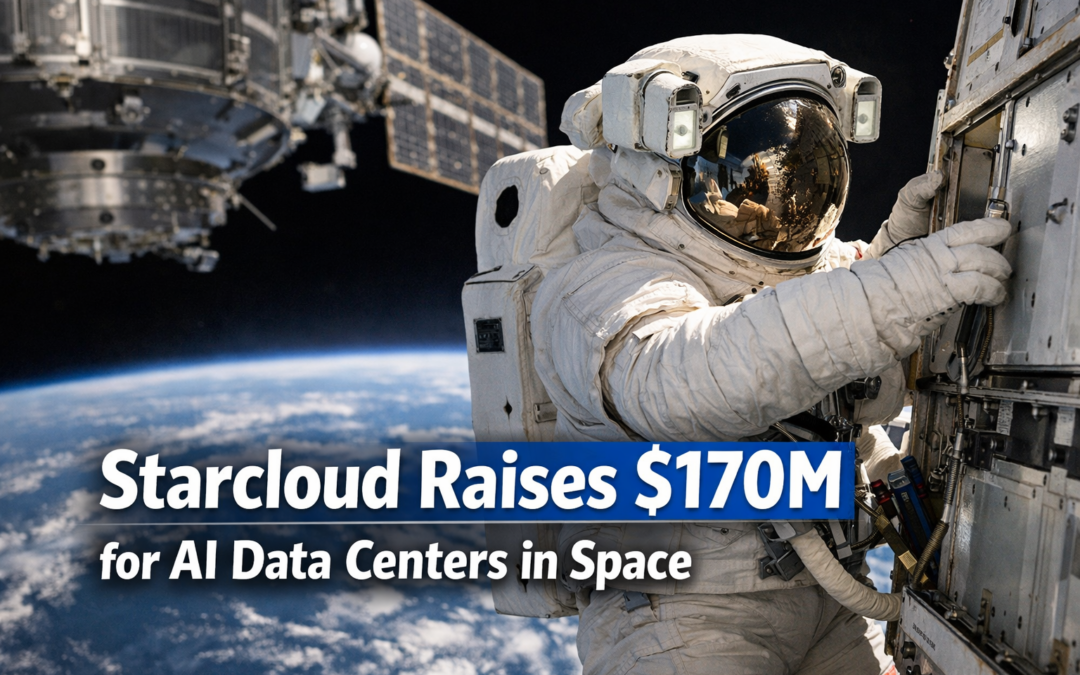
- Starcloud secures $170 million in Series A funding to launch data centers in orbit.
- The company aims to address AI training bottlenecks using space-based compute infrastructure.
- Space data centers promise lower cooling costs and expanded AI capabilities for businesses.
- Developers and AI professionals could access unprecedented computational resources as early as 2027.
A new wave of generative AI demands ever-increasing compute power, straining terrestrial data centers. Starcloud’s $170 million Series A round signals a bold shift: leveraging space for scalable, energy-efficient AI data processing. By placing data centers in orbit, Starcloud aims to reshape how large language models (LLMs) and advanced AI systems find the resources they need.
Key Takeaways
- Starcloud’s orbital data centers promise massive compute scaling for AI training and inference workloads.
- The space environment offers natural cooling and solar energy advantages, potentially lowering operational costs.
- This innovation could democratize access—opening advanced infrastructure to fast-growing startups and global enterprises.
Space: The Next Frontier for Generative AI Compute
AI model complexity rises far faster than chipmakers can optimize for efficiency. Terrestrial data centers battle soaring demand, electricity costs, and urban land constraints. Starcloud bets that orbital data centers—cooled by the vacuum of space and powered by unfiltered solar energy—can overcome these shortcomings.
“Orbital data centers represent a potential quantum leap in AI capability—for developers, startups, and established tech giants alike.”
According to VentureBeat and interviews with Starcloud’s CEO reported by The Wall Street Journal, the first prototypes are slated for deployment as early as 2027. Their unique operating environment may enable up to 20% reduction in cooling costs versus leading earthbound facilities—a crucial factor as energy costs threaten to bottleneck AI scaling. Analysts at Forbes note that space-based compute will be essential to train next-generation foundation models and support worldwide generative AI growth.
Implications for AI Builders and Tech Innovators
- AI Developers: Greater access to high-performance compute accelerates project timelines and model iteration, especially for organizations outside big tech.
- Startups: Lower up-front infrastructure costs could level the playing field, allowing nimble teams to train and deploy LLMs with fewer barriers.
- Enterprise AI: Chief Data Officers may tap into orbital compute for data residency, disaster tolerance, and emerging AI compliance demands.
“The true test for orbital data centers will be bandwidth, latency, and seamless integration with Earth-based AI pipelines.”
Industry experts remain cautiously optimistic. While space offers clear thermal and expansion advantages, reliable high-throughput data links between orbit and ground infrastructure will define real-world ROI. Edge use cases may benefit fastest—especially for models powering space communications, IoT, or low-latency defense applications.
Strategic Questions for the AI Ecosystem
Starcloud’s announcement has already triggered renewed investment interest. Key questions include:
- How quickly can engineering teams tackle challenges in orbital hardware, data movement, and maintenance?
- What role will sovereign nations and global cloud platforms play in regulating space-based compute nodes?
- How will developers and startups get API-level access to these resources in a secure—and affordable—manner?
As generative AI matures, space-based data centers may become critical in resolving compute gridlock. Tech leaders, developers, and entrepreneurs should monitor these launches closely—the landscape for AI infrastructure is about to enter orbit.
Source: TechCrunch