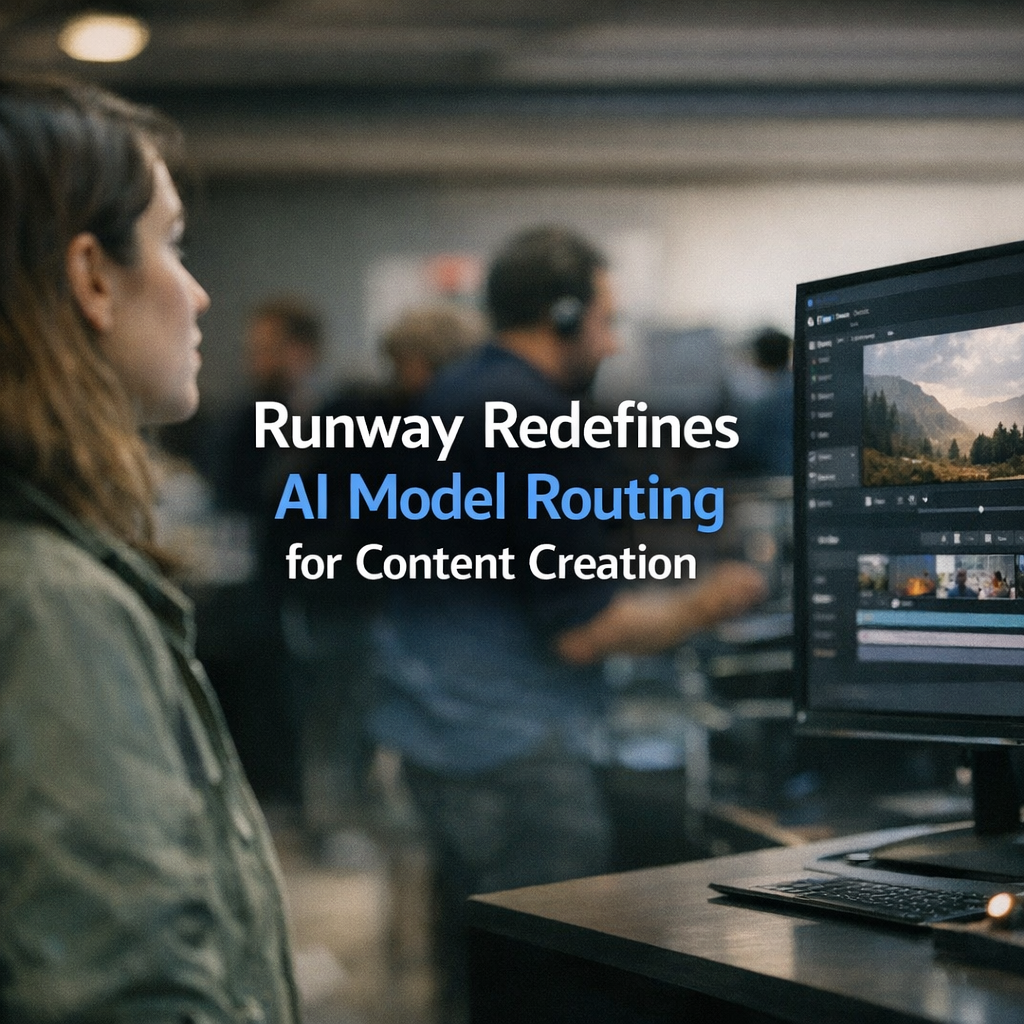
As the generative AI landscape expands rapidly, companies face growing challenges choosing the right models for complex content tasks. Runway, well-known for AI-powered video and media tools, is betting on a new technique called AI model routing to stay ahead as competition among LLMs and generative media models reaches a tipping point. This development signals a major shift toward intelligent orchestration in the AI stack, with crucial implications for product builders, startups, and AI professionals competing in an increasingly crowded space.
- Runway introduces AI model routing to optimize generative media creation
- Model routing allows dynamic selection of the best LLM or generative model per task
- Competition among generative AI startups is intensifying as new models emerge
- Developers and startups must navigate a complex, multi-model ecosystem
- Orchestration and interoperability are set to redefine AI application architecture
Key Takeaways
Runway’s launch of model routing reflects a fundamental transformation as generative AI tools diversify. AI professionals can no longer rely on single-model solutions for consistent performance across tasks. Instead, systems must evaluate and delegate inputs to the most appropriate model, sometimes mixing LLMs, diffusion models, and specialized AI image generators on the fly.
“AI model routing isn’t just a technical upgrade; it’s an emerging paradigm pushing developers to architect applications for interoperability, not just raw power.”
By automating the decision of model selection, Runway seeks to streamline workflows for creators and developers, driving efficiency and unlocking better results while reducing the burden of manually tracking each model’s evolving strengths.
Runway’s Model Routing: How Does It Work?
Runway’s new AI model router functions as an intelligent traffic controller. When a user sends a media generation request—such as turning a prompt into a short video or animating still images—the router analyzes the request to determine which model (from Runway’s own models or compatible third-party models) will produce the most effective output. The underlying framework supports dynamic switching between models, adapting to factors like project type, stylistic preference, or computation constraints.
This approach stands in contrast to traditional fixed-model setups, where all tasks, regardless of their nuance, run through the same AI model. “Runway’s system not only picks the best model per media type, but could soon optimize for frame-level quality, budget, or content style,” further raising the bar for adaptive, user-centric generative AI.
The Competitive Pressures Behind Model Routing
The environment for AI content creation platforms has shifted dramatically in the past year. OpenAI’s Sora generated headlines with lifelike video synthesis, while Stability AI and Pika Labs steadily ship advanced generative visual models. Smaller startups and open-source communities contribute new LLMs and image generators weekly. As a result, comparative advantages between models shift rapidly.
Runway’s solution—a model router that can leverage both proprietary and external models—enables it to stay nimble, improving final outputs and overall user experience whether or not its in-house models lead the market at any given time. According to industry analysts, enabling hybrid, multi-model orchestration is becoming a key survival strategy in generative AI.
“The future of AI content tools will not belong to the model with the highest benchmark, but to platforms that orchestrate, adapt, and integrate the best models at scale.”
Implications for Developers and AI Startups
Architecting for Interoperability
The rise of model routing means developers can no longer treat the AI layer as a static black box. API design, prompt engineering, and deployment pipelines must accommodate—and even anticipate—model diversity and rapid iteration. Tools such as Runway’s router become blueprints for next-generation frameworks that dynamically map tasks to available AI resources.
Strategic Partnering and Monetization
For startups, model routing opens new partnership and revenue opportunities. Model creators can plug into larger routing ecosystems, gaining distribution and feedback while optimizing fit for particular use cases. SaaS companies building on top of these architectures can price outputs based on performance or media quality, not just compute usage.
“Model routing ecosystems could become the backbone for monetizable, modular AI services across verticals—from entertainment to enterprise automation.”
Industry Outlook: Orchestration Will Define the Next Phase of Generative AI
AI-driven creative tools now face a new set of tradeoffs—between model accuracy, speed, creativity, and cost efficiency. Model routing, pioneered by Runway and others, shifts the competitive battleground from pure model training to integration, orchestration, and seamless end-to-end user workflows. Leaders in this emerging space will be those who can navigate the messy, fast-evolving ecosystem of LLMs and generative models to deliver reliable, adaptive, and high-quality products.
The open question now is how quickly standards and APIs for interoperability will arise, and which platforms will set expectations for pluggable, automatically optimized generative AI. Forward-thinking developers and startups have a new mandate: design with orchestration in mind, or risk obsolescence in a crowded, ever-changing model landscape.
Source: TechCrunch