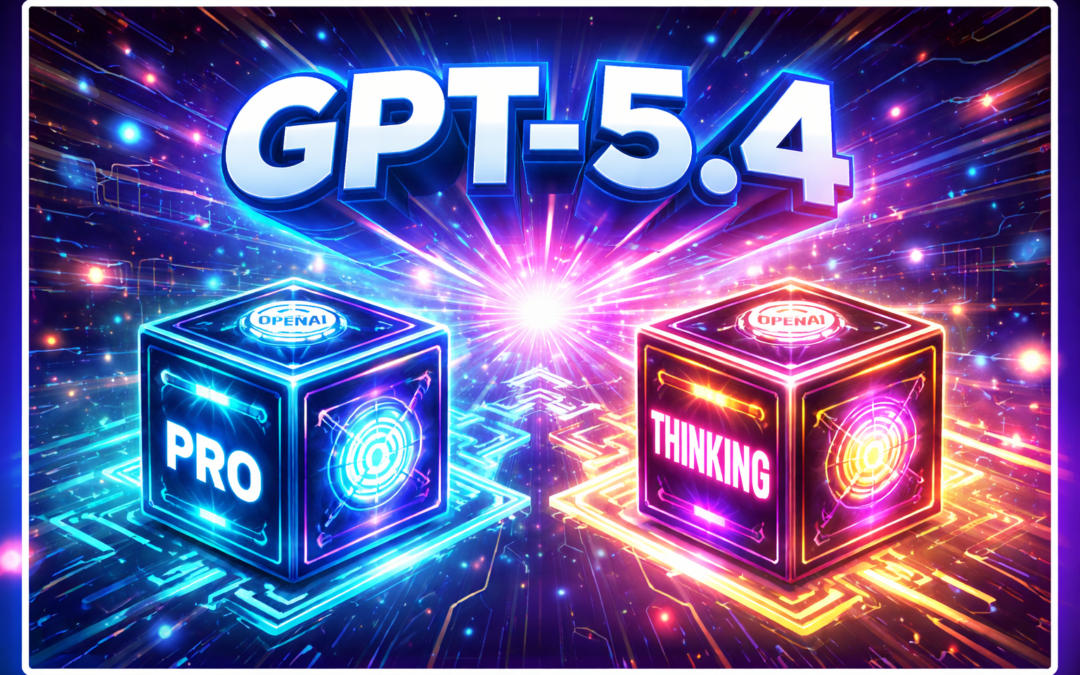
The rapid evolution of generative AI continues, with OpenAI unveiling GPT-5.4, a landmark update featuring distinct “Pro” and “Thinking” versions. This release heightens industry competition and opens novel possibilities for developers, startups, and enterprise AI deployments, signaling a new era for large language models (LLMs).
Key Takeaways
- OpenAI releases GPT-5.4, introducing “Pro” and “Thinking” versions catering to different user needs.
- The “Thinking” model focuses on advanced reasoning, longer context window, and improved multi-modal understanding.
- Pro version emphasizes speed, efficiency, and workflow integration for on-demand AI tasks.
- Rival AI labs like Anthropic and Google are rapidly iterating with competitive LLMs, intensifying the AI arms race.
- For developers and enterprises, GPT-5.4 unlocks new application patterns and more specialized use-cases in production environments.
What Sets GPT-5.4 Apart in the Generative AI Race?
OpenAI’s GPT-5.4 launches as direct competition to Claude 3.5 and Google’s Gemini Ultra, according to reporting from TechCrunch, The Verge, and Ars Technica.
This new generation of LLMs reflects a clear shift toward more differentiated, user-focused offerings.
The introduction of “Thinking” and “Pro” versions exemplifies how leading AI companies now tailor models to specific productivity, creativity, and scientific research scenarios.
With the “Pro” version, OpenAI targets developers and businesses demanding fast, robust task automation and seamless workflow integration. In contrast, the “Thinking” variant boasts longer context support (up to 128K tokens as per OpenAI documentation), coupled with stronger logical reasoning and analytics, further supporting domains like research, code analysis, and multi-modal AI.
Key Features for AI Professionals and Startups
- Context & Composability: Enhanced ability to handle lengthy, complex queries and multi-step workflows.
- Multi-modal Input: “Thinking” supports advanced data types, making it highly valuable for projects using text, images, and code simultaneously.
- API Access & Pricing: The new pricing structure appeals to both rapid prototyping and enterprise scaling, a move designed to fend off competition from Anthropic’s Claude and Meta’s soon-to-be-released Llama 3.
Developers now have unprecedented flexibility, with GPT-5.4 enabling more modular and context-aware AI deployments than any prior OpenAI release.
Implications for the AI Ecosystem
As generative AI adoption accelerates, broader access to sophisticated LLMs like GPT-5.4 reshapes both enterprise and grassroots AI innovation.
Startups can leverage the “Pro” model for cost-effective, scalable productivity tools and digital assistants, while research teams and data-centric industries benefit from the enhanced reasoning of the “Thinking” version.
Google and Anthropic’s rapid launches of advanced LLMs signal that this trend toward model specialization—and fierce rivalry—is just beginning.
For the AI professional community, this means faster iteration cycles, richer integration toolkits, and pressure to differentiate through vertical-specific AI applications.
OpenAI’s dual-model strategy sets a new standard: the era of generic, one-size-fits-all chatbots is ending as tailored LLMs become the norm.
What Should Developers and Teams Do Next?
- Evaluate your current LLM stack for capability gaps, especially if workflow automation or multi-modal reasoning are core to your application.
- Experiment with GPT-5.4’s context extension and “Thinking” logic to unlock new user value and competitive advantage.
- Anticipate faster model refresh cycles—competitive pressure will accelerate iteration and innovation within months, not years.
- Monitor emerging best practices for prompt engineering, model fine-tuning, and privacy, as advanced LLMs become more deeply woven into critical business infrastructure.
Conclusion
OpenAI’s GPT-5.4 is more than a technology upgrade—it’s a turning point that demands attention from anyone building, deploying, or investing in AI.
As LLMs continue to diversify, expect greater momentum toward domain-specific, high-efficiency AI tools.
The next generation of applications will be defined not just by access to powerful models, but by how astutely teams harness them for real, measurable impact.
Source: TechCrunch