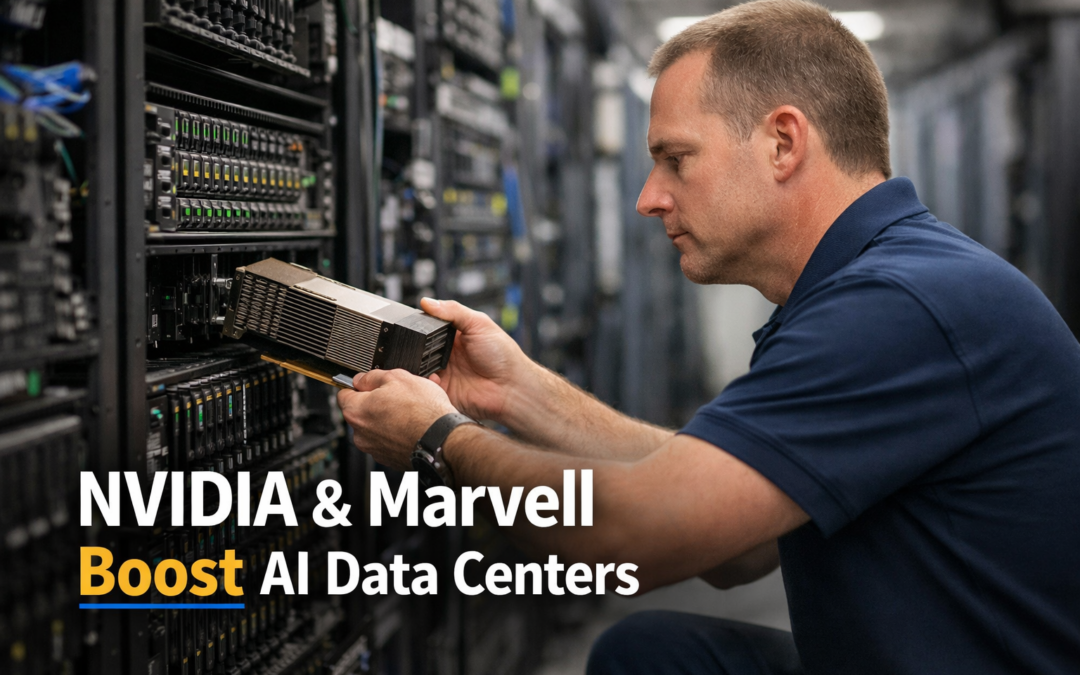
NVIDIA and Marvell’s new partnership, centered on the NVLink-C2C interconnect, signals a major advancement in AI hardware, network speeds, and data center architecture. This development has wide-reaching implications for AI infrastructure, large language model (LLM) training, and generative AI applications.
Key Takeaways
- NVIDIA and Marvell are integrating the NVLink-C2C connectivity on Marvell’s data center solutions, promising faster and more scalable AI workloads.
- This collaboration targets improved network speed and bandwidth in support of next-generation LLMs and generative AI services.
- NVLink-C2C offers reduced latency and higher power efficiency compared to conventional PCIe connections, benefiting high-demand AI environments.
- This ecosystem expansion supports broader hardware innovation, ecosystem flexibility, and accelerates the rollout of custom AI infrastructure.
- Developers and startups stand to gain stronger performance and more modular options for future AI-driven products and services.
Breaking Down the Partnership
NVIDIA’s NVLink has long set the standard for GPU-to-GPU connectivity, and with Marvell joining the ecosystem, this technology pushes into high-performance networking hardware previously outside NVIDIA’s own data center portfolio. According to NVIDIA’s official news release, NVLink-C2C will integrate with Marvell’s Prestera switches and custom silicon, setting the stage for dramatically higher speed and efficiency in AI-centric data centers.
This move directly addresses the bottleneck in scaling LLM training and generative AI inference to thousands – or even tens of thousands – of GPUs in a seamless, high-throughput architecture.
Implications for AI Developers and Startups
With more AI applications relying on real-time processing and massive model parameters, speed and efficiency at the hardware interconnect level are increasingly critical. According to Synced Review and VentureBeat, NVLink-C2C enables custom accelerators and advanced smart NICs to communicate with NVIDIA GPUs at much higher bandwidth – up to 900 GB/sec – than PCIe Gen5, and with lower overhead.
Developers can now build and deploy LLMs and generative AI models that were previously constrained by network throughput. Startups looking to differentiate in AI services – like recommendation systems, AI-powered search, or generative content – benefit from faster time-to-value and more predictability in scaling their products.
“The capacity to directly link custom silicon with NVIDIA GPUs redefines what’s possible in purpose-built AI solutions.”
Strategic Effects on Data Center Infrastructure
This collaboration showcases a shift toward open, heterogeneous AI ecosystems. Marvell’s leadership in high-speed networking, combined with NVLink-C2C’s tight integration, allows cloud providers and enterprise AI teams to rethink both scale and efficiency. According to The Next Platform, this will catalyze more flexible, modular infrastructure, potentially lowering TCO and accelerating innovation cycles for AI professionals.
Expect a rapid acceleration of custom solutions—from edge inferencing appliances to next-gen AI clusters—capable of handling the bandwidth-hungry demands of advanced LLMs and foundation models.
Broad Industry Impact
This partnership fits into a broader trend: modular, specialized, and tightly interconnected AI hardware is becoming the new norm. The expanded NVLink ecosystem—now crossing into networking and silicon beyond GPUs—gives the industry new tools for keeping pace with the exponential growth in generative AI and LLM workloads.
Tech leaders, AI engineers, and infrastructure architects should watch for new reference designs and developer kits in 2024–2025 as Marvell-NVIDIA systems enter the market.
Source: NVIDIA Newsroom
Additional sources:
VentureBeat,
Synced Review,
The Next Platform