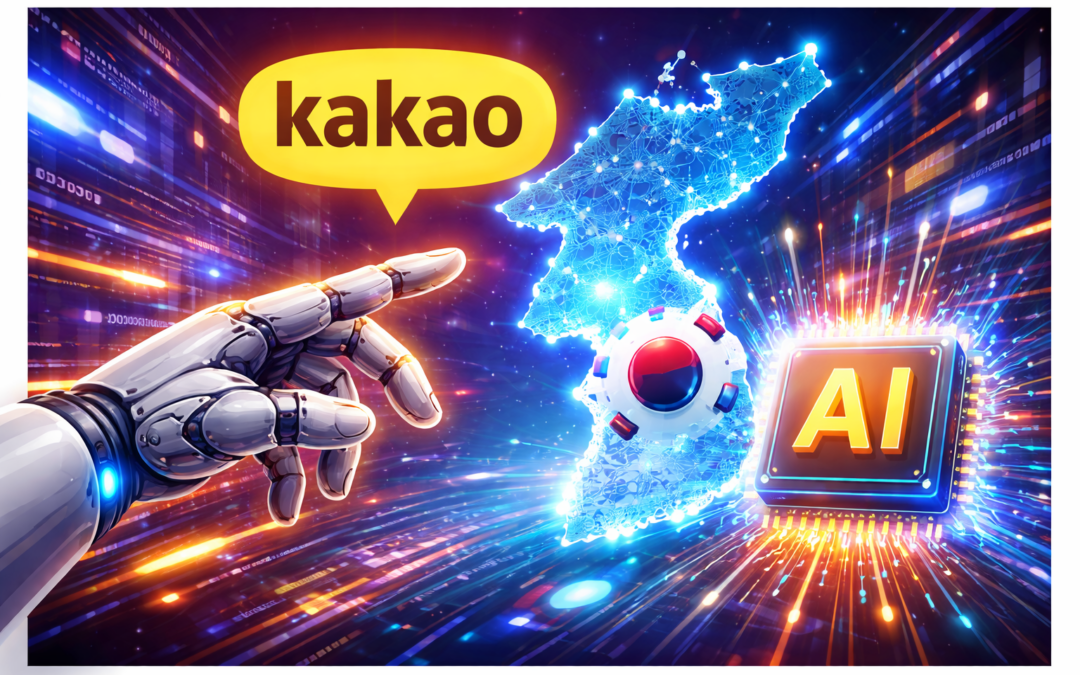
- Kakao has launched a program to boost collaboration between academic AI experts and its in-house AI teams.
- The initiative aims to accelerate real-world adoption of large language models (LLMs) and generative AI within economic and daily-life applications in South Korea.
- Kakao’s push highlights a growing trend of tech companies actively bridging gaps with academic talent to improve cutting-edge AI development and deployment.
South Korean tech giant Kakao has initiated a new collaboration program, designed to connect top academic AI experts with its internal AI engineers. The goal: rapidly fuel advances in large language models (LLMs) and generative AI, spurring broader adoption across industries and consumer-facing services.
Key Takeaways
- Academic–industry collaboration will directly influence development cycles for practical AI tools.
- Kakao is strategically positioning itself to compete with global AI leaders by tapping local research expertise and accelerating AI integration into its product suite.
- South Korea’s AI ecosystem benefits from targeted investment and talent exchanges, strengthening both commercial ventures and scientific progress.
What Kakao’s Program Means for the AI Ecosystem
Many global tech players, from Google to Microsoft, already emphasize joint research with academia. However, Kakao’s initiative signals a more aggressive approach in South Korea—seeking not just research output, but rapid prototyping and deployment for large language models, generative AI-powered chatbots, and personalized recommendation systems.
Kakao’s new program reflects a critical shift beyond theoretical research—AI breakthroughs now target practical use cases, from financial services to messaging platforms.
Analysis: Implications for Developers and Startups
Kakao’s open-door policy for academic experts signals growing opportunities and increased competition for developers and startups. As AI research directly translates to consumer products (messaging, payments, content recommendations), in-house engineers will likely accelerate time-to-market. Startups can anticipate a richer, more dynamic AI marketplace, with more robust APIs and datasets emerging from academic-corporate partnerships.
Expect rapid innovation cycles—developers in South Korea now have unprecedented access to cutting-edge AI models and collaborative platforms.
South Korea’s AI Ambitions on the Global Stage
Other recent news from sources like The Korea Times and The Korea Herald confirms: South Korea wants to carve out a stronger role in global AI. Government campaigns already back AI education and startup incentives. Kakao’s move creates a collaborative channel where both academic and industrial knowledge fuels faster LLM improvement and deployment.
Opportunities and Next Steps
For AI professionals, the Kakao–academic partnership opens doors to more real-world datasets and enterprise deployment scenarios. Researchers and developers gain unique visibility into diverse Korean-language use cases, pushing generative AI tools to new levels of reliability and relevance. Startups may find partnership or acquisition opportunities as Kakao accelerates its innovation drive.
The convergence of deep learning research and industry-grade development could position Kakao—and South Korea—as an influential AI innovator in Asia.
To stay competitive, developers and AI startups should keep an eye on evolving open APIs, collaborative research calls, and ecosystem grants likely to arise as Kakao scales the program. Direct academic engagement may soon become essential for sustained relevance in the rapidly changing AI landscape.
Source: UPI