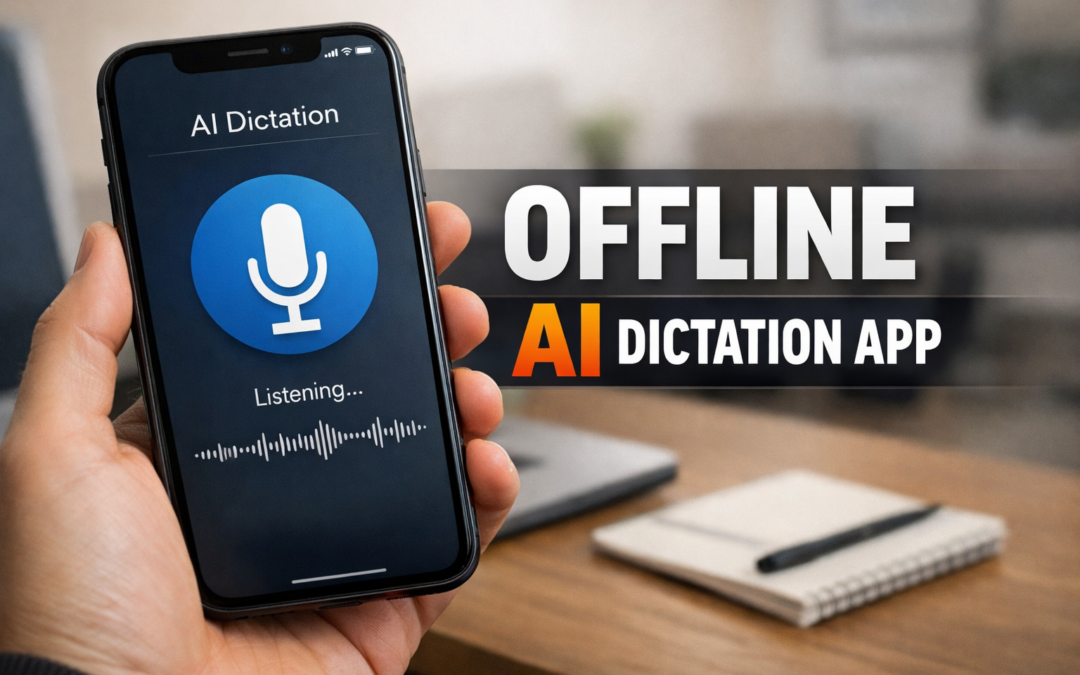
- Google launched an offline-first AI dictation app, “Audio Notes,” exclusively for iOS.
- The app leverages on-device AI for fast, private, and reliable speech-to-text conversion.
- Audio Notes positions Google to rival Apple’s and Microsoft’s voice and note-taking utilities.
- This marks a notable shift toward local AI processing and privacy-centric design in consumer apps.
- The move highlights Google’s intent to increase its AI presence within Apple’s ecosystem.
As generative AI and large language model (LLM) technology evolves, tech giants are embedding advanced AI tools directly into consumer devices. Google’s latest move—quietly rolling out an offline-capable AI dictation app for iOS—signals a new era where on-device intelligence competes head-to-head with cloud-based solutions.
Key Takeaways
- Google’s “Audio Notes” app brings real-time, offline AI transcription to iPhone users.
- Local processing means faster response, minimal latency, and enhanced privacy.
- The app expands Google’s AI footprint beyond Android and the web.
What Is Audio Notes — And Why Does It Matter?
Google’s “Audio Notes” app, now available on iOS, allows users to record voice memos and convert speech to text without sending data to external servers. Leveraging advanced on-device LLMs, Audio Notes promises accurate dictation and transcription even while offline, differentiating itself from many voice recording apps that rely on constant internet connectivity.
Local AI processing lets users privatize their data and access features instantly—without waiting for cloud-based computations.
Competing apps like Apple’s native Voice Memos or Microsoft’s AI transcription in OneNote require either manual transcription or online connectivity. Audio Notes is designed to offer an always-available solution for professionals and individuals who prioritize privacy and speed.
Technical Highlights
- Runs neural inference entirely on-device to preserve user privacy and enable real-time use.
- Integrates with iOS’s system-level sharing and reminders, according to MacRumors.
- Employs a compact yet robust speech recognition model—rumored to use a version of Google’s own Gemini Nano for iOS.
Implications for Developers, Startups, and AI Professionals
Google’s foray into offline AI apps on iOS challenges conventional app paradigms and presents new competitive benchmarks.
- Developers should consider the growing feasibility of running sophisticated LLMs and generative AI models directly on mobile devices, reducing reliance on expensive cloud processing and latency issues.
- Startups can seize opportunities to build privacy-respecting, offline-first AI tools for consumers and enterprise deployment, especially as user awareness of data privacy grows.
- AI professionals must tune models for speed and efficiency on edge devices while solving constraints unique to local inference and storage
The offline-first design signals a broader industry trend: AI is becoming core to user experiences—even when connectivity is unreliable or privacy is paramount.
Competitive Context and Market Dynamics
Relying on comprehensive reporting by TechCrunch, The Verge, and 9to5Google, Google’s release positions “Audio Notes” among leading dictation solutions. Its offline AI focus differentiates it from the likes of Otter.ai, Apple’s built-in Voice Memos, and Microsoft’s Office suite, which all hinge (to varying degrees) on cloud backend infrastructure.
This direct challenge between local AI and cloud AI is likely to inspire rapid model size optimization, tighter hardware-software integration, and fierce platform competition over AI-powered user experiences.
Looking Forward
As more consumers demand control over their data and rapid feature response, the norms for AI-powered apps are shifting. Google’s “Audio Notes” is an early indicator that the next generation of generative AI apps will increasingly live at the edge—on the hardware users already carry.
Offline-capable AI isn’t just about privacy; it unlocks productivity and creative tools for millions, regardless of network status.
Expect similar moves from rivals as the AI industry pivots toward hybrid models, where edge computing and the cloud work in synergy to maximize user value.
Source: TechCrunch