Advancements in AI continue to blur boundaries between artificial and natural intelligence. Recent research highlights remarkable similarities when scientists tasked both mice and an advanced AI model with the same problem-solving challenge. Below is a breakdown of the study’s findings, their wider context, and implications for the AI field.
Key Takeaways
- AI large language models (LLMs) and mice demonstrated similar problem-solving patterns on identical navigation tests, supporting the idea of convergent intelligence.
- The study adds evidence that AI systems may mimic biological reasoning under certain conditions, enhancing understanding of how both process novel environments.
- This parallel between machine and animal cognition has practical implications for robotics, AI tool design, and neuroscience research.
- Findings highlight potential collaborative opportunities between AI researchers and neuroscientists aiming to develop more natural, adaptable algorithms.
AI and Mice: Tackling Identical Challenges
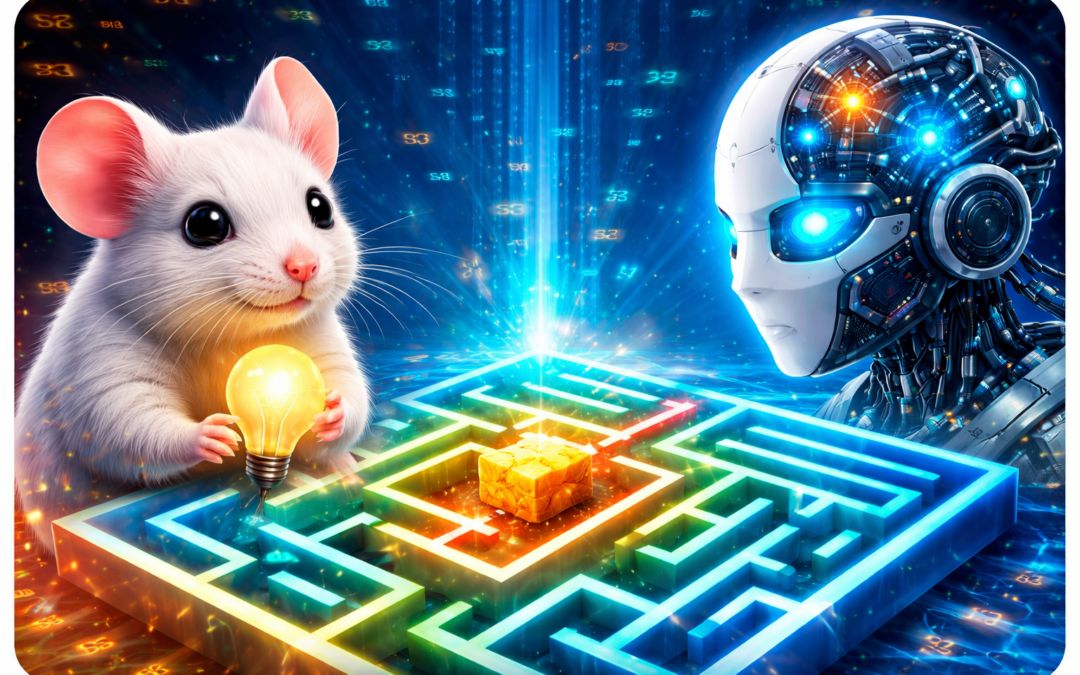
A research team, as reported by The Economic Times and corroborated by coverage in New Scientist, assigned mice and OpenAI’s GPT-4-powered agent the task of locating an escape route from a maze-like environment. Both entities encountered new rooms and needed to exploit partial cues to navigate successfully.
The AI model and mice exhibited strikingly similar learning curves and behaviors, even when the task required trial-and-error adaptation.
Researchers measured strategy, persistence, and adaptation rates. Surprisingly, the GPT-4 AI agent made decisions similar to those of the rodents, suggesting that fundamentally different architectures can converge on shared problem-solving pathways when navigating unknown environments.
Analysis: Why Does This Matter for the AI Community?
For developers and startups eager to push the boundaries of generative AI and LLMs:
- Model Generalization: The results reinforce the growing belief that advanced AI systems can move beyond pattern recognition to behavioral adaptation, especially when placed in real-world scenarios.
- Algorithmic Inspiration: Insights from biological cognition (e.g., how mice probe, remember, and adapt) could inspire more resilient and flexible AI models for robotics and adaptive control.
- Testing and Benchmarking: Aligning AI evaluation with benchmarks from neuroscience brings new rigor to the development of trustworthy, human-aligned AI tools.
These results could reshape how researchers evaluate and design AI systems for tasks that demand real-time adaptation in uncertain contexts.
Implications for Real-World Applications
This study emphasizes that the convergence between animal and artificial intelligence is not just theoretical—it has concrete takeaways for multiple sectors:
- Autonomous Systems: Developers building AI for robotics, navigation, and exploration can validate models with tasks inspired by animal cognition, making systems more robust in physical spaces.
- AI Research and Tooling: Startups creating AI-driven diagnostic or decision-support tools can consider benchmarks informed by biological intelligence to improve performance.
- Cross-Disciplinary Collaboration: Neuroscientists and AI professionals investigating cognitive architectures now have new common ground for joint research and innovation, as demonstrated in this and similar studies (Nature).
The Road Ahead
As large language models and generative AI systems approach, and in some senses mirror, the learning processes of biological brains, the future of AI may lie in cross-pollination between neuroscience and artificial intelligence. Both communities can accelerate progress by refining tasks that test not just output accuracy, but the quality and adaptability of learning itself.
AI can now compete with living brains in adapting to unfamiliar challenges, marking a pivotal moment for the trajectory of intelligent systems.
Strategic collaborations and innovative benchmarks will increasingly determine who leads the next wave of AI breakthroughs—making studies like these essential touchpoints for any technology leader or researcher working at the intersection of intelligence, adaptability, and real-world performance.
Source: The Economic Times