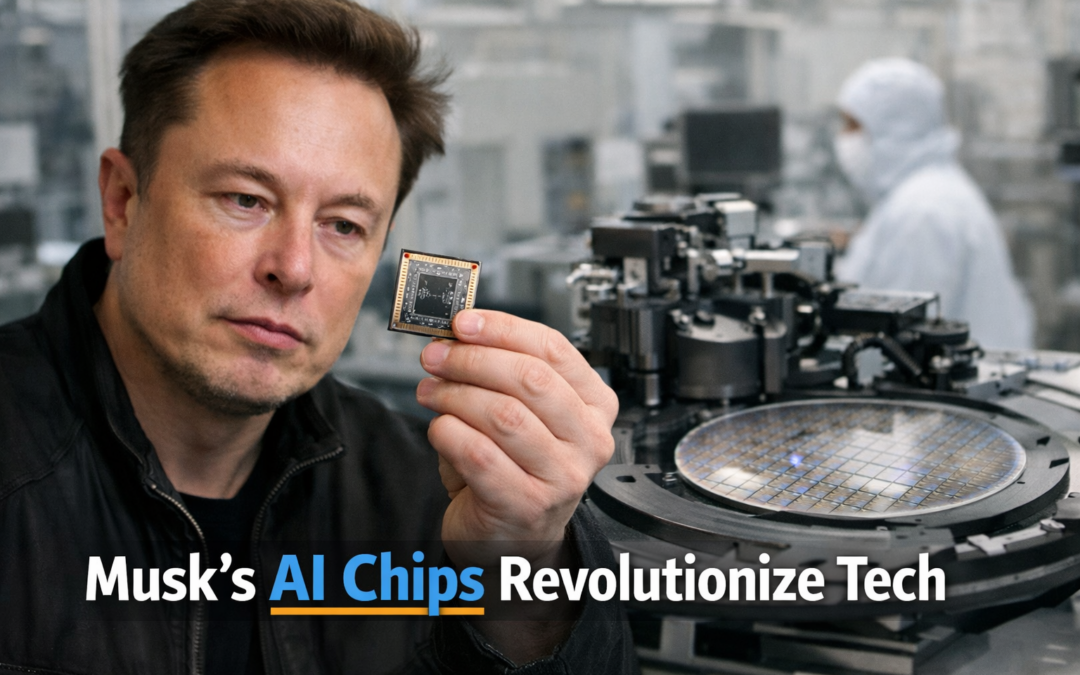
Elon Musk’s latest announcement shakes up the global AI and hardware landscape, as SpaceX and Tesla reveal their ambitious in-house chip manufacturing initiatives. This move targets advances in large language models, generative AI, and next-gen robotics, and signals a push for greater self-reliance across AI development and deployment.
Key Takeaways
- Elon Musk has confirmed plans for both Tesla and SpaceX to produce custom AI chips in-house rather than relying solely on third-party suppliers like Nvidia or TSMC.
- The initiative aims to meet rising computational needs of LLMs, generative AI products, and autonomous systems fundamental to both companies.
- Industry analysts expect this to intensify competition in the AI hardware sector and disrupt established supply chain dynamics.
Musk’s Strategic Shift to In-House AI Chips
According to TechCrunch and confirmed by additional coverage from CNBC and Reuters, Musk positions chip manufacturing as a core pillar for future AI innovation at Tesla and SpaceX. Both companies plan to develop their own advanced processors designed specifically for data-heavy applications in autonomous vehicles, robotics, and real-time satellite data analysis. By reducing dependence on global giants like Nvidia, Tesla and SpaceX can optimize their chip architectures for unique product needs, secure their supply, and potentially reduce long-term costs.
“Elon Musk’s chip initiative signals a new era of vertical integration across the AI and hardware stack, with far-reaching implications for innovation speed and global competition.”
Implications for Developers and AI Professionals
For developers and AI professionals, enhanced access to bespoke hardware could create new possibilities in model training, inference speed, and edge AI deployments. Tesla’s hardware focus already yields significant results — recent Full Self-Driving (FSD) improvements, for example, stem from tight hardware-software integration. If these in-house efforts scale as intended, expect:
- Lower-latency, power-efficient chips tailored for real-time inference tasks in vehicles, robots, and satellite systems.
- Expanded capacity for high-throughput LLM training – critical for next-generation generative AI tools.
- Faster iteration cycles as software teams collaborate directly with hardware architects, reducing bottlenecks common with off-the-shelf silicon.
“Developers can expect a dramatic boost in AI performance and reliability as Tesla and SpaceX roll out custom silicon designed for their unique workloads.”
What Startups and the AI Ecosystem Need to Watch
This bold bet on vertical integration isn’t risk-free. In-house AI chip design requires massive upfront investments, access to semiconductor fabrication, and constant R&D cycles to keep up with Moore’s Law. However, when successful — as evident in breakthroughs from Apple’s M-series chips and Google’s TPUs — purpose-built silicon can deliver decisive market advantages.
Startups now operate in an environment where tech leaders embrace full-stack control: from data, to model, to hardware. This sets higher expectations for performance and innovation. Emerging AI companies and toolmakers must watch these trends closely, as customer demand increasingly shifts to products built on such specialized chips.
“The AI hardware arms race is now front and center, forcing every player — from startups to cloud giants — to rethink where true differentiation happens.”
Industry Outlook
Market analysts from SEMI and Gartner predict explosive growth for the AI chip market through 2030, with leaders moving from general-purpose to sector-specific silicon. Musk’s move, if executed well, may set a standard for deep vertical integration — a blueprint other AI-first companies might follow to stay competitive in generative AI, robotics, advanced driver-assist systems, and edge computing.
Key takeaway: The race for AI supremacy now extends beyond training data and model architecture; it’s a race for the most optimized, tightly-integrated hardware.
Source: TechCrunch