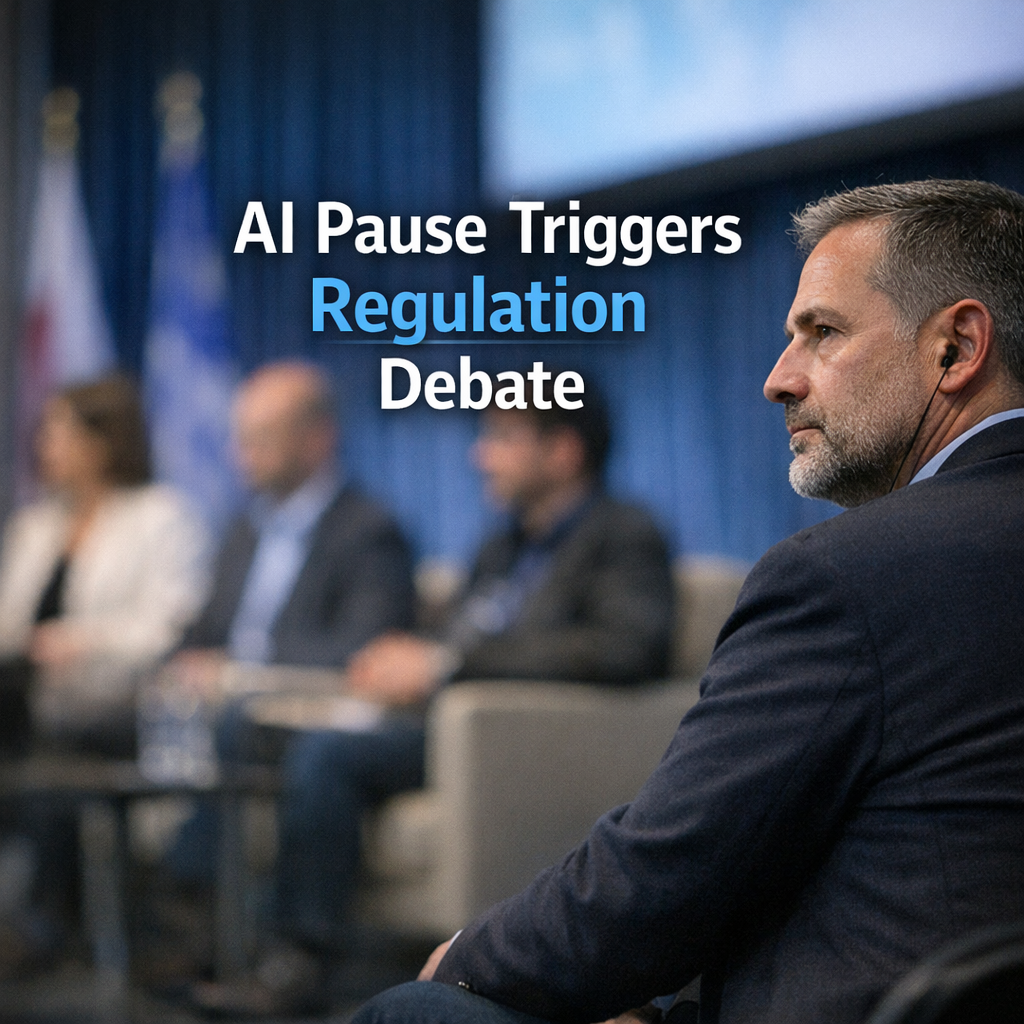
Global conversations about AI safety and regulation have escalated dramatically, as political leaders and technologists debate the risks and trajectory of advanced language models. A new wave of calls for a pause in AI development—most recently signed by senator Bernie Sanders—exposes sharp divides among policymakers, tech CEOs, and researchers. This debate directly impacts developers, AI startups, and industry strategists confronted with novel regulatory risk and market uncertainty. Balancing innovation, ethics, and the explosive momentum of generative AI is the defining challenge facing the sector today.
- Rising political and expert demands for an AI development “pause” intensify regulatory uncertainty.
- The Sanders-signed open letter adds fresh momentum to calls for a slowdown on large-scale LLM training.
- Developers and startups now face heightened scrutiny and a potential shift in compliance requirements.
- The debate reflects urgent anxieties about responsible deployment and existential AI risk.
- Policy, industry, and research camps remain deeply divided on the cost–benefit calculus of stalling AI progress.
Key Takeaways
- Bernie Sanders joins prominent voices urging a temporary halt on frontier LLM training, adding political heft to a campaign previously driven by technologists and ethicists.
- Regulators worldwide are under pressure to address the risks of super-powerful generative AI systems, including misinformation, labor disruption, and potential misuse.
- Tech sector stakeholders must now anticipate regulatory shifts and assess how slowdowns or moratoria could reshape product roadmaps and investment priorities.
“Calls for an AI development pause reflect escalating concern that technical innovation is outpacing society’s ability to govern its consequences.”
Political Push for an AI Pause Accelerates
The public campaign for a temporary halt in the training of large-scale AI models gathered new momentum as Bernie Sanders joined signatories on a high-profile open letter. This action comes after recent efforts by figures like Elon Musk, Yoshua Bengio, and Max Tegmark, who have advocated for a slowdown to reassess the dangers of advanced generative AI systems. The letter urges all developers working on models more capable than current leading LLMs (like OpenAI’s GPT-4 and Google’s Gemini) to suspend further scaling for at least six months.
“Bringing prominent political leaders into the AI pause movement could tip the legislative balance, compelling tech firms to rethink timelines and transparency.”
Divided Voices: Tech Innovators, Policymakers, and Researchers Spar
While some policymakers and AI researchers warn that uncontrolled advances may threaten societal stability, key industry leaders remain sharply opposed to blanket pauses. CEOs at companies like Anthropic and OpenAI have repeatedly championed robust self-regulation paired with technical safeguards, arguing that innovation should continue under stricter oversight.
In contrast, critics of the pause—including Yann LeCun and many open-source advocates—contend that halting LLM progress will only concentrate power in the hands of a few large U.S. and Chinese corporations. Some governments, such as the European Union, have moved forward with draft regulations targeting foundation model development, while China is accelerating its own generative AI deployment under heavy state guidance.
Compliance Headwinds for Startups and Developers
The specter of an enforced development pause or even harsher controls introduces profound compliance and operational challenges for AI startups and independent developers. Companies already subject to privacy and content moderation rules could soon face new requirements on model training data transparency, compute usage disclosures, and third-party auditing.
“Startup founders and engineering teams must now architect not only for technical excellence, but also for rapidly shifting regulatory terrain worldwide.”
Practical Impacts: Product Roadmaps, Investment, and International Competition
Uncertainty around a potential AI pause reverberates through multiple industry layers. Venture funding for foundational AI models—projected at over $27 billion globally in 2023—could slow if investors fear regulatory action. Product teams scaling language and multimodal applications may pivot toward more narrowly targeted systems or double down on model safety research.
Internationally, differing regulatory approaches could spark uneven progress: The U.S. and EU may see slower model rollouts, while rival AI hubs in China and the Middle East move swiftly to capitalize on market openings. Cross-border collaboration on AI governance—pitched as essential by institutions like the United Nations—remains fraught with competing interests and a lack of concrete enforcement mechanisms.
“In a landscape of fragmented AI rules, competitive advantage will favor those that integrate trust, transparency, and compliance into every layer of development.”
What Comes Next for AI Regulation and Development?
The push for an AI development pause signals a turning point for the global tech sector: regulatory action has shifted from abstract debate to urgent, high-stakes negotiation. For AI professionals, anticipation of stricter guidelines and heightened transparency is no longer optional—it is a core business consideration. The race to define responsible innovation, risk controls, and public trust will frame the next era of generative AI progress. As lawmakers negotiate new rules and industry explores technical governance tools, the AI community stands at a pivotal crossroads—one that will shape the field for years to come.
Source: The Guardian