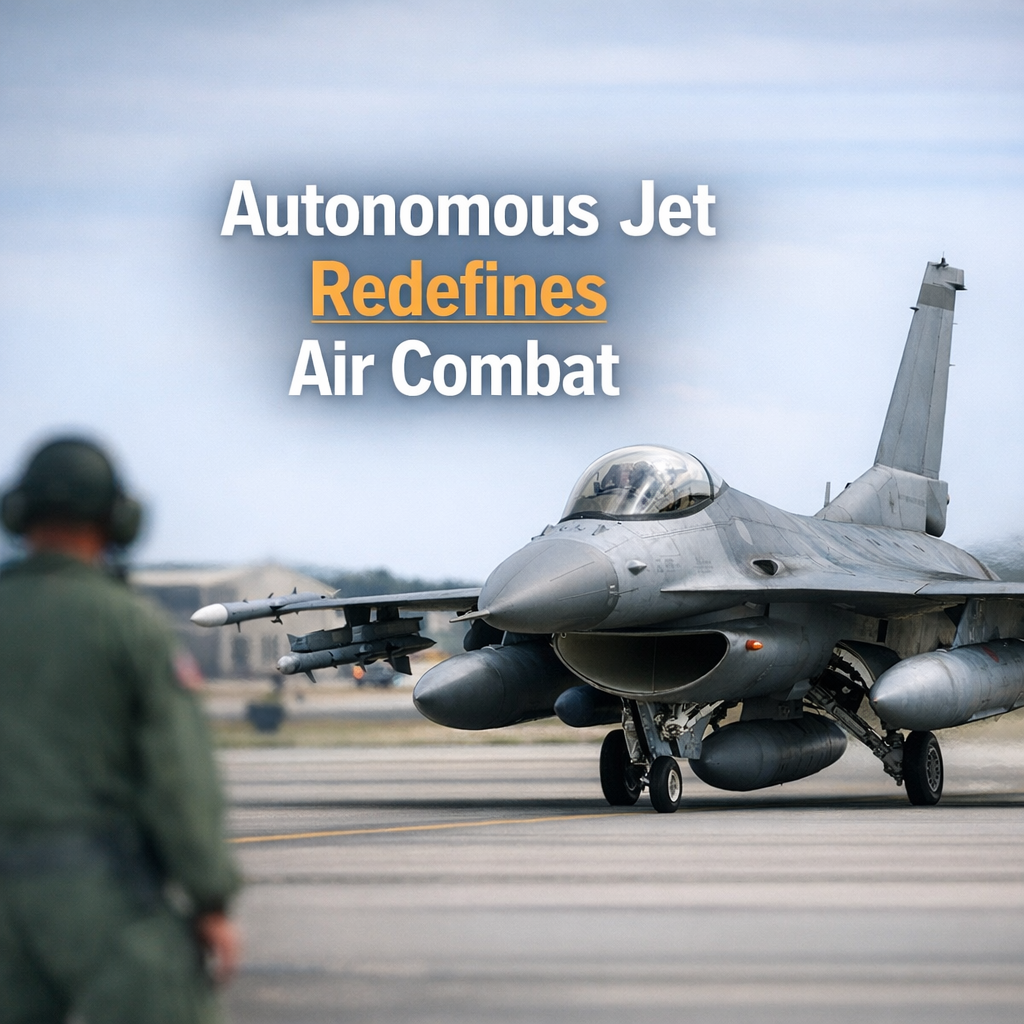
Artificial intelligence just made a high-speed debut in the cockpit. In a significant leap for both autonomous systems and military aviation, an AI system flew and won simulated dogfights maneuvering a real F-16 fighter jet, according to recent disclosures by the US Air Force and DARPA. This milestone blends advanced LLM-powered algorithms with real-world aviation, setting a precedent that will ripple across the AI, defense, and aerospace communities. The news carries enormous implications for safety, performance, and the future interface between human pilots and machine intelligence.
- AI pilots have successfully controlled a modified F-16 at high speeds and in complex dogfighting scenarios.
- This demonstration marks a major validation of AI’s operational safety and decision-making in real flight, not just simulation.
- Open-source LLMs and tailored algorithms power the autonomy stack, foreshadowing dual-use applications beyond military aviation.
- The collaboration signals growing investment from both DARPA and the Air Force in autonomous air combat and next-gen AI controls.
Key Takeaways
AI’s mastery of in-air maneuvers in actual F-16 fighter jets signals that generative AI is maturing well beyond text—and entering high-stakes, safety-critical real-world operations. For startup founders, developers, and established AI professionals, this serves as a compelling proof-of-concept with wider applications possible in logistics, defense, and robotics. The project’s success pivots on blending reinforcement learning, LLM coordination, and sensor-rich physical systems—technologies central to next-gen AI solutions.
The era of AI-limited to simulations has ended; real jets guided by machine intelligence have taken to the skies and outmaneuvered human pilots.
AI Flies an F-16: Inside the Breakthrough
The successful AI-controlled flights took place as part of DARPA’s Air Combat Evolution (ACE) program. Engineers equipped a specially modified F-16 known as the X-62A (VISTA) with an autonomy stack driven by a combination of LLM-driven logic and advanced reinforcement learning policies. The test AI went head to head with human pilots in simulated dogfights, ultimately prevailing in several instances, and proved capable of executing complex aerial maneuvers at over 550 mph.
This was not a remote-control scenario. The AI processed in-cockpit sensor data, evaluated threat surfaces and navigated dynamic environments to make split-second tactical decisions—all in real-time and under strict safety oversight. Onboard safety pilots monitored the AI’s actions, able to retake control instantly, but did not find it necessary during critical test segments.
Real-world AI dogfighting validates that LLM and RL-based systems can withstand the unpredictable forces, G-loads, and data streams unique to flight.
From Simulated Dogfights to Real-World Readiness
While AI has dominated simulated air combat in contests like AlphaDogfight, this marks the first public instance of a machine piloting a real jet through advanced aerial maneuvers—and crucially, doing so with a safety record that allowed continuous testing over months.
The project revamped standard LLM architectures, fusing them with RL frameworks and physics-based control models. According to coverage in CNN and Defense News, the software managed variables like wind shear, adversary positioning, and evasive logic, adapting on the fly. The demonstrations at Edwards Air Force Base underlined the confidence of the Air Force in AI’s ability to cooperate and compete with humans without compromise on safety or mission goals.
AI pilots are no longer sci-fi speculation—they are test-proven, data-driven operators trusted with real hardware in the world’s most demanding airspace.
What This Means for Developers and Innovators
For those building the next wave of generative AI and LLM-powered systems, the implications are profound:
- Safety-critical validation: AI is now sustainably operating in high-fidelity, high-risk use cases—providing a benchmark for reliability and explainability that will influence both open-source and proprietary toolchains.
- Edge AI and defense tech: Companies from Anduril to Shield AI and even major defense primes face a shifting landscape, where LLM-enabled autonomy stacks are fast becoming the new standard in unmanned and optionally manned systems.
- Cross-domain innovation: The technical lessons from in-flight agility and decisioning flows will transfer to disaster response drones, logistics, autonomous vehicles, and even civilian aerospace automation.
Startups and enterprise AI teams should prepare for an ecosystem where regulatory scrutiny intensifies, but the rewards for robust, validated autonomy will multiply.
Who’s Building the Next Generation of AI Pilots?
DARPA’s ACE effort involves partnerships with prime integrators, upstart AI labs, and open-source communities driving LLM advances. Agencies in the US, China, and Europe are all racing to field AI that can not only outperform human pilots in battlespace scenarios but also collaborate seamlessly as wingmen, test pilots, and mission planners.
The push to open-source key AI autonomy components will accelerate civilian adaptation. As investment pours in, expect waves of startups targeting adjacent sectors—energy, logistics, and public safety among them—with proven-in-flight tech at their core.
“First to real-world deployment” will define the winners in the generative AI arms race, transforming both defense and civilian aviation markets.
Looking Ahead: The Future Takeoff of Generative AI in the Real World
The flight of an AI-controlled F-16 stands not just as a technical feat, but as a notice to every AI professional and founder: generative AI and LLMs are poised to move from language and prediction into physical, world-shaping action. New regulatory frameworks, trust benchmarks, and hybrid human-machine teaming models will become core priorities. Those who adapt fastest to the realities—and risks—of real-world AI autonomy will set the pace for the industry’s coming decade.
Source: DARPA