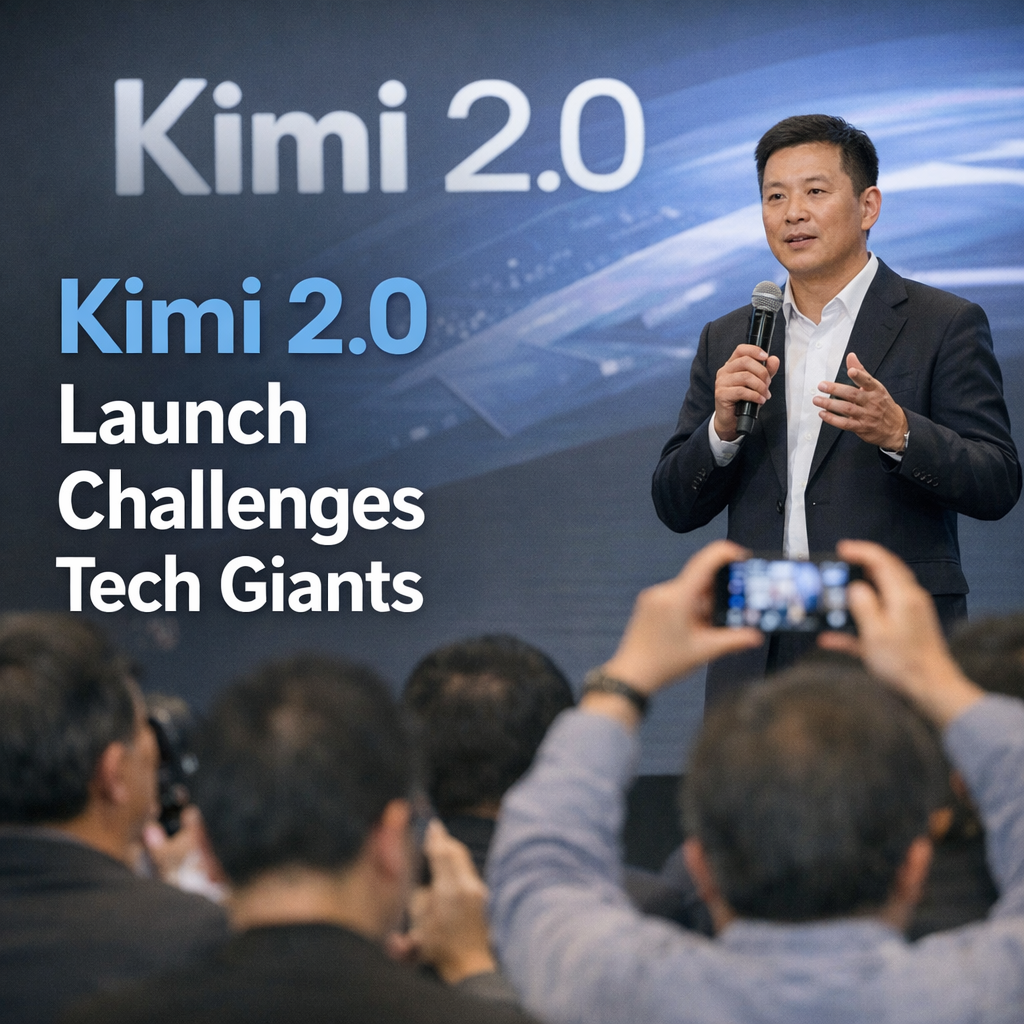
The global AI race is rapidly evolving, with new contenders emerging outside Silicon Valley. This week, China’s Moonshot AI disrupted the landscape by launching Kimi 2.0—an advanced, cost-efficient large language model (LLM) designed to rival heavyweights like OpenAI and Anthropic. For startups, developers, and enterprises tracking generative AI, Moonshot’s move marks a major inflection point in both market accessibility and technological innovation.
- China’s Moonshot AI releases Kimi 2.0, aimed at challenging the dominance of industry leaders in large language models.
- Kimi demonstrates competitive benchmarks at a fraction of the cost associated with leading Western LLMs.
- This development signals a rapidly tightening tech race between Chinese and US AI firms.
- Impacts include new opportunities for AI tool creators and changing economics for incumbents across the ecosystem.
Key Takeaways
Moonshot AI’s Kimi brings a new wave of competition to the LLM sector with evidence-backed performance metrics and significant cost savings over American counterparts. The landscape no longer belongs exclusively to OpenAI, Google, or Anthropic. Kimi’s release points to a future where high-functioning generative AI is not only more affordable but also more globally distributed—which has direct implications for developers, founding teams, and established technology providers watching for share shifts and new value creation opportunities.
“High-caliber LLMs are no longer a Western monopoly—Moonshot AI’s Kimi 2.0 proves China’s tech firms have both the ambition and technical chops to shake up the global market.”
Moonshot Kimi 2.0: The Specs and Strategy
Moonshot AI’s Kimi 2.0 reportedly features 200 billion parameters, positioning the model on par with or above many US-developed models. Early benchmark results show Kimi is adept at English and Chinese tasks, with its cost-to-performance ratio outpacing GPT-4 and Claude 3 family models according to several open leaderboards (referencing New York Times, South China Morning Post, and local Chinese tech media). Moonshot is aggressively subsidizing API pricing, setting Kimi’s access costs to undercut global rivals by wide margins.
Kimi’s inclusion of enterprise-ready safety and compliance features aligns with tightening Chinese AI regulations, positioning it as a go-to choice for domestic enterprises needing generative AI at scale.
“By making high-performance LLMs dramatically more affordable, Moonshot forces global competitors to respond—either by cutting prices, improving features, or both.”
Benchmark Wars: How Kimi Stacks Up
Moonshot’s academic and commercial benchmarking places Kimi in the top ranks, with particularly strong performance in mathematical reasoning and long-context understanding. Recent OpenCompass and LMSYS evaluations (as cited by SCMP) have Kimi edging out earlier versions of ChatGPT on Chinese-language benchmarks, and closing in on GPT-4 Turbo in English tasks. Moonshot’s leadership claims that Kimi can handle up to 200,000 tokens of context—outstripping most major competitors for document analysis and coding-intensive workflows.
“Scalable LLMs with deep context memory unlock new possibilities for enterprise integrations, closing the gap between AI product vision and commercial deployment.”
The Geopolitical AI Chessboard: Implications for Global Startups
China’s rapid LLM advances are leading global VCs and established tech giants to rethink assumptions about AI innovation. With Moonshot’s $1 billion in recent fundraising and its valuation now reported above $3 billion, the capital influx behind Chinese frontier models is headline-worthy. For international founders, open-source AI tool creators, and API-based SaaS startups, this forces a recalibration of go-to-market and partnership strategies, as access to affordable, powerful models increases in both the East and West.
In parallel, Chinese tech conglomerates like Alibaba and Baidu are fast-tracking their own competitive LLMs and deep learning platforms, intensifying the national innovation race and drawing further global investment focus toward China’s AI ecosystem.
“As the East accelerates in generative AI, savvy startups and enterprise buyers worldwide gain more leverage—it’s now a seller’s market for LLM infrastructure.”
Developer Opportunity and the Rising API Economy
Kimi’s API-first launch model expands horizons for developers eager to integrate advanced AI on a budget. From conversational agents to document analysis tools, Moonshot’s lower API rates pave the way for more experimentation and new product entrants both in China and internationally (where Chinese LLM access is permitted). Security, compliance, and performance comparisons will increasingly shape which APIs become standard in SaaS, fintech, and workflow automation stacks.
For AI professionals, the competitive feature set—including larger context windows and better cross-lingual handling—means a richer toolset to deploy, test, and iterate upon for end users, researchers, and commercial teams alike.
Pushing the Industry Forward
The arrival of Kimi 2.0 pressures global AI leaders to accelerate innovation, reduce prices, and broaden feature sets. As generative AI becomes more accessible and the leading edge is no longer confined to US-based labs, the next wave of growth will depend on how quickly companies and developers adapt to a more diverse, more price-sensitive AI supply chain. Expect the battle for model supremacy to become even more intense, with localization, regulation, and real-world deployment complexity driving the next iterations of this technology revolution.
Source: Reuters